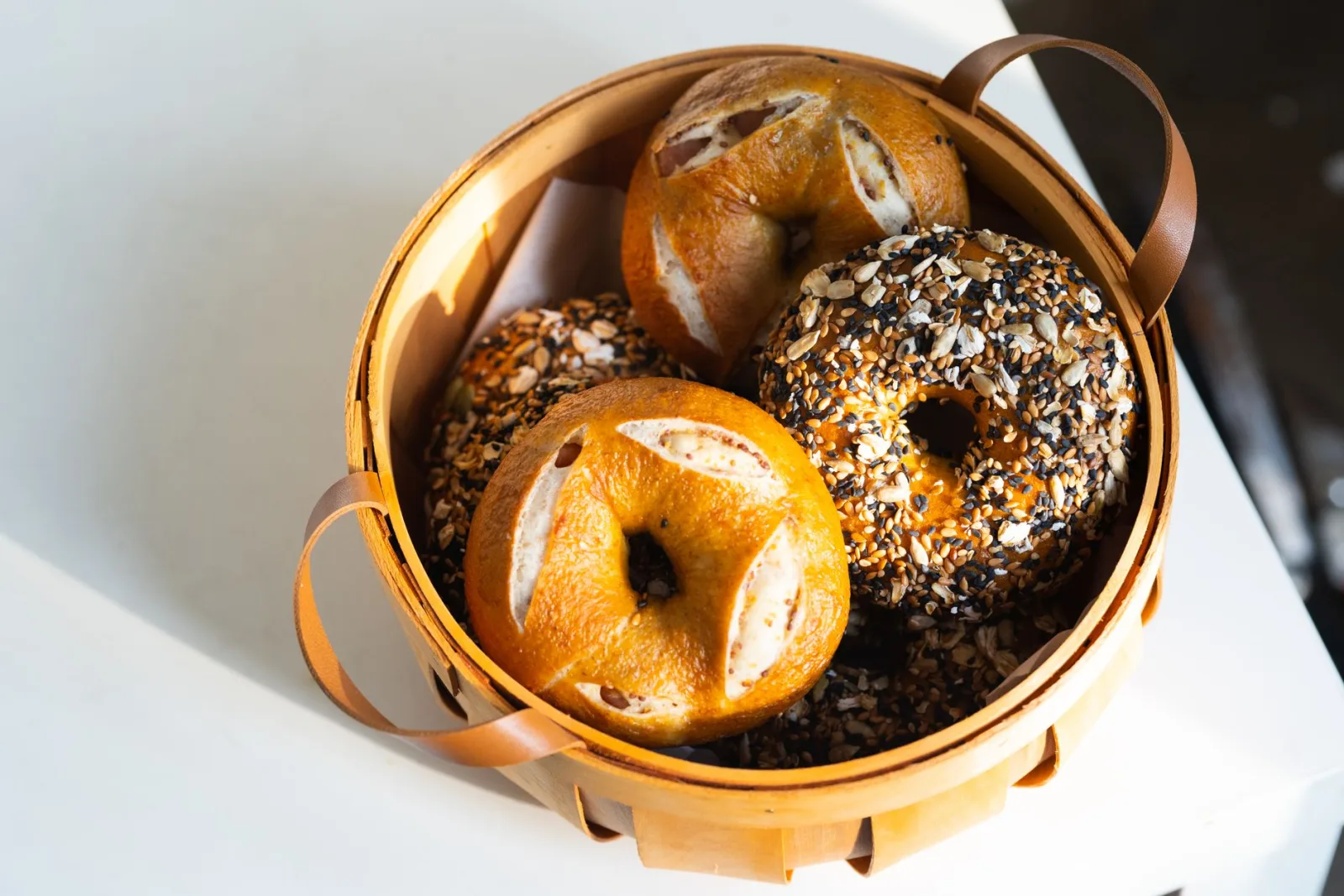
In short:
- First written trace: Krakow, 1610. The bagel is a Polish bread, documented in the seventeenth century.
- The Viennese legend of 1683 does not hold, it postdates that mention by 73 years.
- The word comes from Yiddish beygl, from a Germanic root that simply means ring.
- What makes a bagel is the boiling. Without the water step it is a round bread, not a bagel.
The origin of the bagel is one of those subjects where the good story has largely displaced the sources, to the point of appearing on the placemats of the chains that sell them. It is false, and the real one is simpler.
On a brunch menu, what matters more still is that most of the “bagels” served are not technically bagels. The tipping point is one minute of cooking.
What the sources say: Krakow, 1610
The earliest known written mention appears in the regulations of the Jewish community of Krakow, Poland, dated 1610. The beygls turn up in a very concrete context: they are among the gifts customarily given to women who have just given birth.
Two things follow. First, the bread already existed and was common enough to be covered by a regulation, which pushes it back further still. Second, this is a central European bread, rooted in the daily life of Ashkenazi Jewish communities, not a courtly invention.
The word points the same way. Beygl is Yiddish, tied to a Germanic root for a ring or a curved object, the same as the German Bügel. The name describes the shape, nothing more.
The Viennese legend, and why it fails
The story is well built, which explains its longevity. In 1683, after the siege of Vienna was lifted, a Viennese baker is said to have created a bread shaped like a stirrup, Bügel in German, in tribute to King John III Sobieski of Poland, whose cavalry had won the battle.
The problem is arithmetic: the Krakow mention dates from 1610, 73 years earlier. The bagel was already an identified, named and regulated bread at the moment the legend claims it was born.
What remains plausible in the story is the play on the word Bügel, which probably fed the account after the fact. As a birth certificate, it has to be set aside.
How it reached New York
The bagel crosses the Atlantic in the late nineteenth century with the mass Eastern European Jewish migration to New York. It settles in the Lower East Side, first as a community bread, sold by the piece in the street and threaded onto sticks.
What follows is a textbook case of a closed trade. The New York bagel bakers’ union, founded in the 1930s, tightly controlled production: a capped membership, near-hereditary entry, techniques kept within families. For decades the New York bagel was an artisanal and rationed product.
That lock breaks in the 1960s with the arrival of shaping machines, which industrialise production and move the bagel from the neighbourhood to the supermarket. That is when it becomes an American national product, and also when it starts losing what defined it.
What actually makes a bagel: the boil
This is the only criterion that counts, and it is technical: a bagel is boiled before it is baked, thirty seconds to a minute per side.
That water step gelatinises the starch at the surface. Three consequences:
- The crust sets before the oven, which stops the dough rising any further.
- The crumb stays dense and chewy, the opposite of an open bread crumb.
- The surface turns glossy, and holds seeds.
A round bread with a hole, shaped and baked directly, is not a bagel: it is a savoury roll in the shape of a ring. The difference shows when it is cut, the crumb is too airy, and it is obvious in the bite. It is the exact opposite of the work wanted on a rich leavened dough such as old-fashioned brioche, where the whole technique aims at developing that open structure.
The brunch test is simple: if the bagel squashes when it is filled, it was not boiled.
New York against Montreal, two distinct schools
The two cities pushed the same bread apart, and these are not minor variants.
| New York | Montreal | |
|---|---|---|
| Boiling water | barley malt | honey |
| Oven | conventional | wood-fired |
| Salt in the dough | yes | no |
| Size and hole | larger, narrow hole | smaller, wide hole |
| Taste | neutral, salty, chewy | sweet, drier, fire-marked |
The Montreal bagel is the more recognisable of the two, and the furthest from what most people in Europe call a bagel, where the New York school dominates the menus.
What it changes when ordering
On a brunch table the price gap between an industrial bagel and one boiled that morning is real, and it is almost never visible on the menu. Three useful markers:
- The gloss of the crust. Matt and floury means it was not boiled.
- The weight in the hand. A real bagel is surprisingly heavy for its size.
- How it holds a filling. It should carry cream cheese and fish without sagging, which is exactly what is expected of a salmon avocado bagel.
Same reasoning as for the rest of the formula, set out in what is brunch: the difference in production cost is minimal, the difference in result is not.
Frequently asked questions
What is the origin of the bagel?
The earliest known written trace dates to 1610, in the regulations of the Jewish community of Krakow, Poland, where beygls are listed among the gifts customarily given to women who have just given birth. The bagel is therefore a central European bread, documented in the early seventeenth century, and it reached North America in the late nineteenth century with Eastern European Jewish immigration.
Was the bagel invented in Vienna in 1683?
No, and this is the most widespread legend on the subject. It holds that a Viennese baker shaped a bread like a stirrup to thank King John III Sobieski of Poland after the siege of Vienna. The story is appealing but it postdates the Krakow mention of 1610 by 73 years, which is enough to rule it out as a birth certificate.
What does the word bagel mean?
The word comes from the Yiddish beygl, itself tied to a Germanic root meaning a ring or a curved object, the same root as the German Bügel. The name simply describes the shape of the bread, not any particular historical event.
Why is a bagel boiled before baking?
Thirty seconds to a minute in boiling water gelatinises the starch at the surface. That sets the crust before the oven, stops the dough rising further, and produces the characteristically dense, chewy crumb along with the glossy surface. A round bread simply put in the oven is not a bagel, whatever its shape.
What is the difference between a New York and a Montreal bagel?
The Montreal bagel is boiled in honeyed water then baked in a wood-fired oven, which makes it sweeter, thinner and more marked by the fire. The New York one is boiled in barley-malt water, salted in the dough, larger and chewier, with a smaller hole. These are two distinct schools, not two variants of one bread.