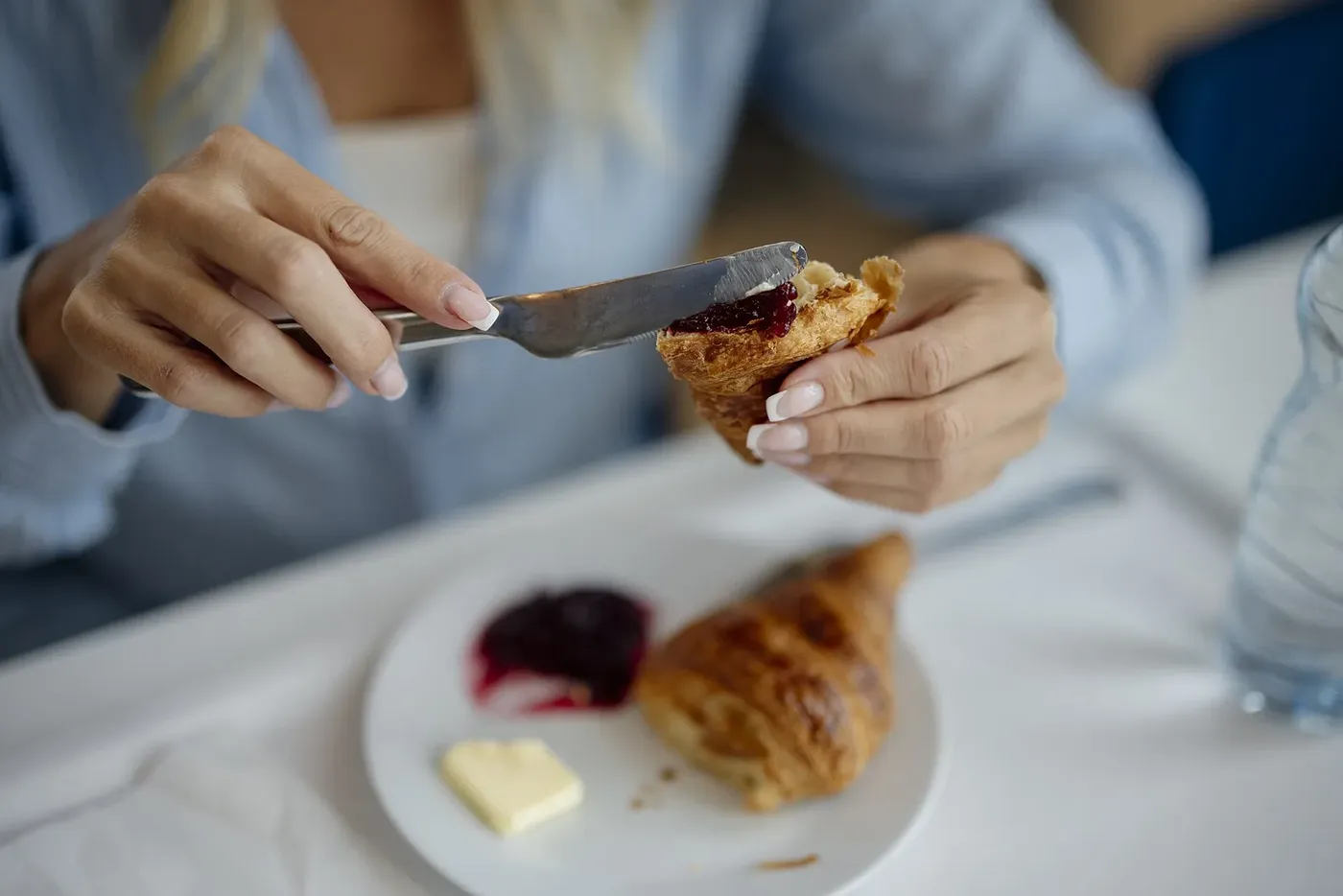
In short:
- A tray holds up if it covers four families: hot drink, cereal base, something fresh, a source of protein.
- The reference quantity per person is about 80 to 100 g of cereal base, 150 g of fruit, 125 g of yoghurt or one egg, 250 to 300 ml of hot drink.
- Almost everything can be made the night before, except eggs, toast, hot drinks and avocado.
- On a tray in bed, the constraint is not contents but stability: low containers, cups filled two thirds.
Building a breakfast tray is less a matter of taste than of logistics. The contents take minutes to choose, but it is the quantities, the order of preparation and the way the tray sits that decide whether the moment is pleasant or the morning is spent in the kitchen.
The four families to cover
A balanced tray does not call for a shopping list, only for leaving no box empty.
- A hot drink. Coffee, tea, chocolate. It gives the moment its shape, and it is almost always the least considered part.
- A cereal base. Bread, pastry, oats, pancakes. It provides the volume.
- Something fresh. Whole fruit, fruit salad, juice. It brings the acidity that cuts through fat and sugar.
- A source of protein. Egg, yoghurt, cheese, ham, nuts.
The fourth is almost always the one missing. A tray made of a pastry, a juice and a coffee is pleasant and does not last two hours. Adding an egg or a yoghurt changes neither the preparation time nor the look of the tray, but it changes the morning.
Quantities per person
| Family | Breakfast | Brunch replacing lunch |
|---|---|---|
| Cereal base | 80 to 100 g, 2 slices or 1 pastry | 120 to 150 g |
| Fresh fruit | 150 g | 200 g |
| Protein | 125 g yoghurt or 1 egg | 2 eggs, or 1 egg and cheese |
| Hot drink | 250 to 300 ml | 350 ml, often poured twice |
| Savoury | optional | 80 to 100 g, half the table |
Two cues that prevent over-preparing:
- The number of preparations matters more than the quantities. Three things done well beat seven of which four came out of a packet.
- Be generous on bread and coffee, exact on everything else. They are the only two items where a shortage is noticed immediately.
On what exactly brunch is and at what time it is served, the article what is brunch sets out the frame and the budgets.
What can be made the night before
This is where the morning is won. The rule is simple: anything that is neither hot nor avocado-based can be done the night before.
The night before:
- The fruit salad, covered, without banana or apple, which brown.
- Cold porridge or soaked oats, which genuinely improve after a night.
- Granola, which keeps for weeks in a jar.
- Waffle or pancake batter, whose rest really improves the texture.
- Laying the tray itself: cutlery, napkins, cups, sugar, everything that is not eaten.
- Setting up the coffee: beans weighed, water ready, filter in place.
In the morning only:
- Eggs, in every form.
- Toast, which softens within minutes.
- Hot drinks.
- Anything containing avocado, which oxidises in under an hour.
On that last point, the avocado toast recipe explains why the flesh may be prepared ahead but is never spread on bread before service.
Breakfast in bed is a stability problem
Breakfast in bed rarely fails on its contents. It fails because a tray resting on a duvet has no footing.
What works:
- A tray with raised edges, to hold back whatever slides.
- Low, wide containers rather than tall, narrow ones. A bowl is steadier than a mug, a squat glass safer than a flute.
- Cups filled two thirds, never to the brim.
- Nothing hot at the edge of the tray, preferably in the centre, on the carrier’s side.
- No food that needs a knife. Cutting requires pressing down, and a tray on a duvet sinks.
If the tray has to wait a few minutes, a drink served very hot in a thick container beats a lukewarm one in a thin cup.
The order of service when something is hot
As soon as a hot item joins the tray, the order stops being free. Hot things cool at very different speeds.
- Coffee or tea last, just before carrying the tray.
- Eggs just before that, since they tolerate waiting badly.
- Toast before the eggs, left on a rack rather than flat, or steam softens it.
- Everything cold laid out first, on waking or the night before.
The same logic applies to a brunch table for several: cold is laid out in advance, hot goes out in waves. For waffles, the trickiest case since they soften in a stack, the method is set out in the article on crisp and fluffy waffles.
That leaves the drink. It is the most neglected item, though the most noticed: brunch coffee gives the quantities and the settings. For a cold alternative, how to make a smoothie covers the proportions that avoid a lukewarm, runny drink.
The most common tray mistakes
- Serving everything at once. The hot items cool while the rest is laid out.
- Multiplying small containers. A tray loaded with six ramekins becomes impossible to carry and to set down.
- Forgetting the protein. The most common mistake, and the only one that is paid for two hours later.
- Toasting the bread too early. Five minutes is enough to make it soft.
- Serving iced juice with scalding coffee. The temperature gap flattens both.
Frequently asked questions
What should go on a breakfast tray?
A tray holds up if it covers four families: a hot drink, a cereal base such as bread or a pastry, something fresh such as fruit or juice, and a source of protein such as an egg, yoghurt or cheese. The fourth is almost always the one missing, and it is what separates a tray that lasts until lunch from one that leaves a gap at eleven.
How much food per person for breakfast?
Count roughly 80 to 100 g of cereal base, meaning two slices of bread or one pastry, 150 g of fresh fruit, 125 g of yoghurt or one egg, and 250 to 300 ml of hot drink. For a brunch standing in for lunch, quantities rise by about half and savoury takes more space than sweet.
What can be prepared the night before?
Almost everything except hot items and avocado. Fruit salad, cold porridge, granola, waffle and pancake batter, the laying of the tray itself and the coffee set-up all benefit from being done the night before. Only eggs, toast, hot drinks and anything containing avocado are made in the morning.
How do you get breakfast in bed right?
The constraint is stability, not contents. A tray with raised edges, low wide containers rather than tall ones, cups filled two thirds and no hot liquid at the edge of the tray. Anything needing a knife is dealt with in the kitchen, since a tray resting on a duvet offers no resistance.
Does a breakfast tray need something savoury?
French breakfast is traditionally sweet, but a savoury element changes satiety and avoids the morning sugar spike. An egg, a slice of ham or a piece of cheese is enough. At brunch, which replaces a meal, savoury is no longer optional but half the table.