In short:
- The best established benefit is fibre, roughly 10 g for two tablespoons.
- The omega-3 are real but in a plant form the body converts poorly.
- The useful dose sits around 15 to 30 g a day, no more.
- The seeds must be hydrated before being swallowed, the one precaution that genuinely matters.
The benefits of chia seeds are real, but they are not the ones the marketing around the product puts forward. The seed is no miracle food: it is a very good source of fibre, a decent source of plant protein, and a source of omega-3 whose value needs qualifying.
What two tablespoons hold
The reference portion, about 28 g, or two tablespoons:
| Nutrient | Approximate amount | Share of daily intake |
|---|---|---|
| Energy | 135 to 140 kcal | about 7 % |
| Fibre | 9 to 10 g | about 30 % |
| Protein | 4.5 to 5 g | about 8 % |
| Fat | 8 to 9 g | mostly omega-3 |
| Calcium | 175 to 180 mg | about 20 % |
| Magnesium | 90 to 95 mg | about 25 % |
The figure that stands out is fibre. Few everyday foods supply that much in such a small volume: two tablespoons cover roughly a third of the recommended daily intake, which is considerable in a Western diet where that intake is structurally too low.
Mucilage, the only immediately noticeable effect
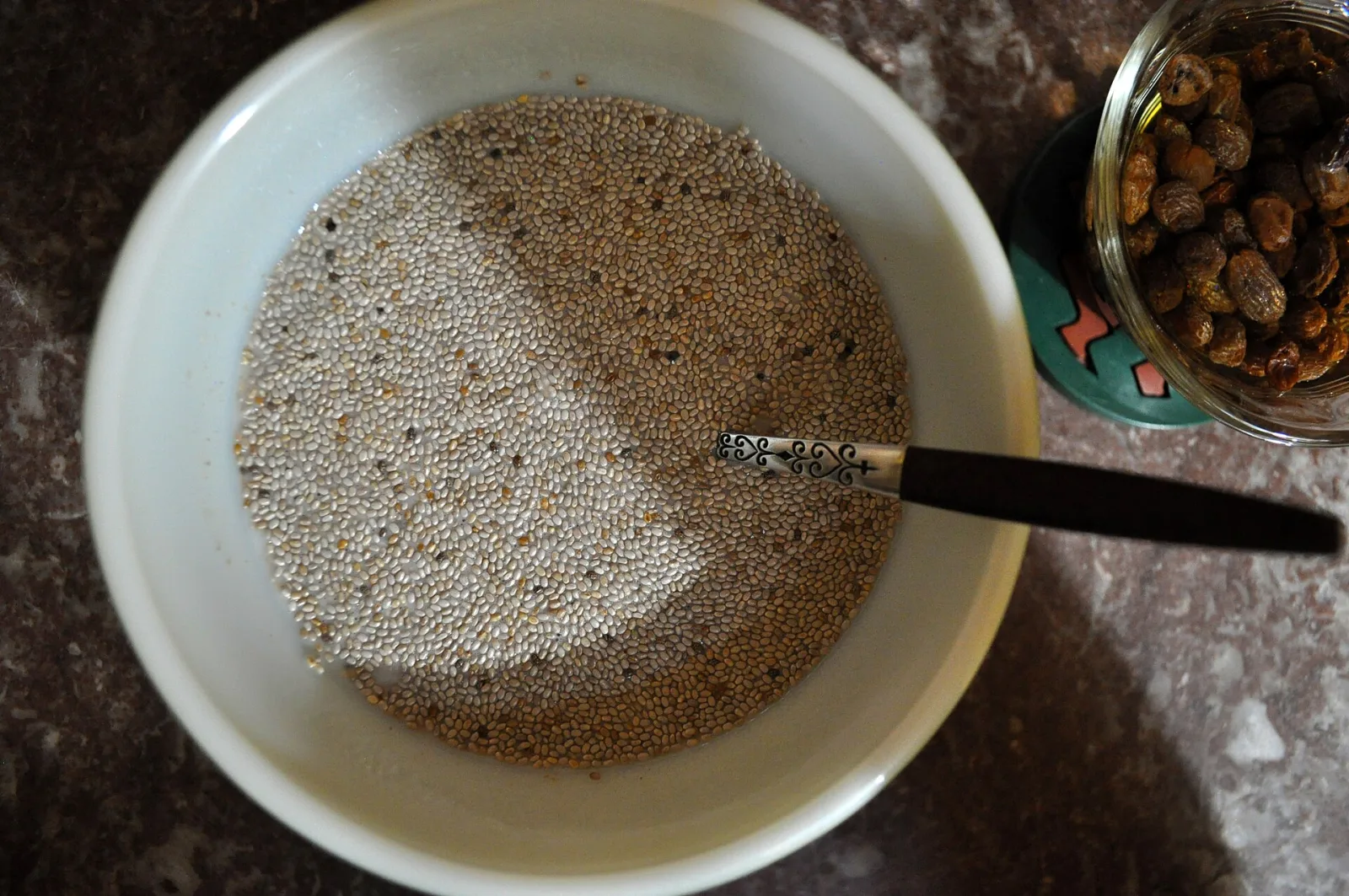
On contact with liquid, chia seeds coat themselves in a clear gel, the mucilage. That is what lets them absorb several times their weight in water and turn a bowl of milk into a firm pudding within hours.
This gel is not a texture detail, it is the main mechanism:
- It slows gastric emptying, so it extends the feeling of a full stomach.
- It slows the absorption of carbohydrates from the meal, which softens the glycaemic spike following a sweet breakfast. The general principle is covered in the article on a low GI breakfast.
- It increases the volume of the food mass without adding calories.
That is why a spoonful of chia in a yoghurt holds better than a yoghurt alone, for barely 70 kcal more. It is a measurable comfort effect, not a slimming one: the seeds do not remove calories, they push hunger back.
Omega-3, to be qualified
This is the most promoted argument and the most often poorly explained.
Chia seeds are indeed one of the best plant sources of omega-3. But this is alpha-linolenic acid (ALA), not the EPA and DHA found in oily fish, to which most of the studied cardiovascular and cognitive benefits are attached.
The human body can convert ALA into EPA and then DHA, but the yield of that conversion is low, in the order of a few per cent, and it varies between individuals. The practical consequence: two tablespoons of chia do not replace a portion of sardines or mackerel.
That does not make the intake useless. ALA has value of its own, and for a vegetarian or vegan diet, chia remains a relevant source. The honest phrasing is simply: a good source of plant omega-3, not a substitute for oily fish.
Calcium and minerals
The stated figure of around 180 mg of calcium per two tablespoons is accurate, and it is often compared to milk. That comparison needs two qualifications.
First, the seeds contain phytic acid, which binds part of the minerals and reduces their absorption. Second, the real portion stays small: nobody eats 100 g of chia a day, yet the comparison is almost always made on that basis.
Magnesium is the soundest contribution of the lot, around a quarter of the recommended intake for two tablespoons, with no direct competition from another breakfast food.
How much to use, and in what form
The commonly held dose is one to two tablespoons a day, or 15 to 30 g. Beyond that, the fibre load becomes uncomfortable for many people.
Three uses work at breakfast:
The pudding. Three tablespoons to 200 ml of milk or plant drink, one night in the fridge. It is the preparation that best exploits the mucilage, and it is made the day before, which suits a rushed morning.
In a smoothie. One tablespoon blended with the rest. It thickens the drink within ten minutes and brings the fibre this format often lacks, as covered in the berry smoothie.
In granola. Mixed into the oats before baking, they take part in cluster formation without being noticeable under the tooth. The principle is explained in the homemade granola recipe.
Chia seeds are naturally gluten free, which makes them a useful addition to the constrained breakfasts covered in the article on a gluten-free breakfast, provided the packaging statement is checked in case of coeliac disease, because of cross-contamination.
The two precautions that matter
Always hydrate before swallowing. This is the only genuinely important precaution. Dry seeds swallowed as they are, followed by a large glass of water, can swell in the oesophagus; cases of obstruction have been reported in the medical literature, in people consuming the seeds dry. Mixed into a liquid or a yoghurt before eating, the problem does not arise.
Increase gradually. Going from zero to three tablespoons a day in a diet previously low in fibre almost always causes bloating and discomfort. Half a spoon for a few days, then one, is enough to allow time to adapt.
Chia or flax, the price question
The two seeds have close nutritional profiles, with a clear cost advantage for flax, often two to three times cheaper per kilo.
| Chia seeds | Flax seeds | |
|---|---|---|
| Fibre | very high | high |
| Omega-3 (ALA) | high | high |
| Needs grinding? | no | yes, otherwise not absorbed |
| Keeping once ground | not applicable | rancid within weeks |
| Gelling | strong | moderate |
| Price per kilo | high | moderate |
The practical difference is mostly convenience: flax has to be ground to release its nutrients, and it goes rancid quickly once ground, while chia is used whole and keeps for a long time. That is what the price gap buys, not a clear nutritional superiority.
Frequently asked questions
What are the benefits of chia seeds?
The best established benefit is fibre: roughly 10 g for two tablespoons, close to a third of the daily recommended intake. That fibre forms a gel on contact with liquid, which slows gastric emptying and extends satiety. The seeds also bring plant protein, magnesium, phosphorus and omega-3 in the form of alpha-linolenic acid, whose value is real but commonly overstated.
How many chia seeds per day?
One to two tablespoons, or 15 to 30 g a day, is the commonly held dose. Beyond that, the fibre load becomes uncomfortable for many people, with bloating and digestive discomfort, especially if water intake does not follow. The increase should be gradual when the diet was previously low in fibre.
Do chia seeds make you lose weight?
No, no single food causes weight loss by itself. Their real effect is indirect: the soluble fibre they contain swells in the stomach and extends the feeling of fullness, which can reduce intake at the next meal. It is a comfort effect that does not replace a calorie deficit, and it disappears if the seeds are added to an already substantial breakfast.
Do chia seeds need soaking?
Yes, in most uses, for two reasons. Soaking releases the mucilage, the gel carrying most of the satiety effect, and it avoids the risk of swallowing dry seeds that would then swell on contact with liquid. Twenty minutes is enough for a decent texture, a night in the fridge gives a firm pudding.
Chia or flax seeds, which to choose?
Both have close profiles, with a clear cost advantage for flax, often two to three times cheaper. The practical difference lies elsewhere: flax has to be ground to be absorbed, and it goes rancid quickly once ground, while chia is used whole and keeps for a long time. Chia mostly pays for its convenience and its gelling power.