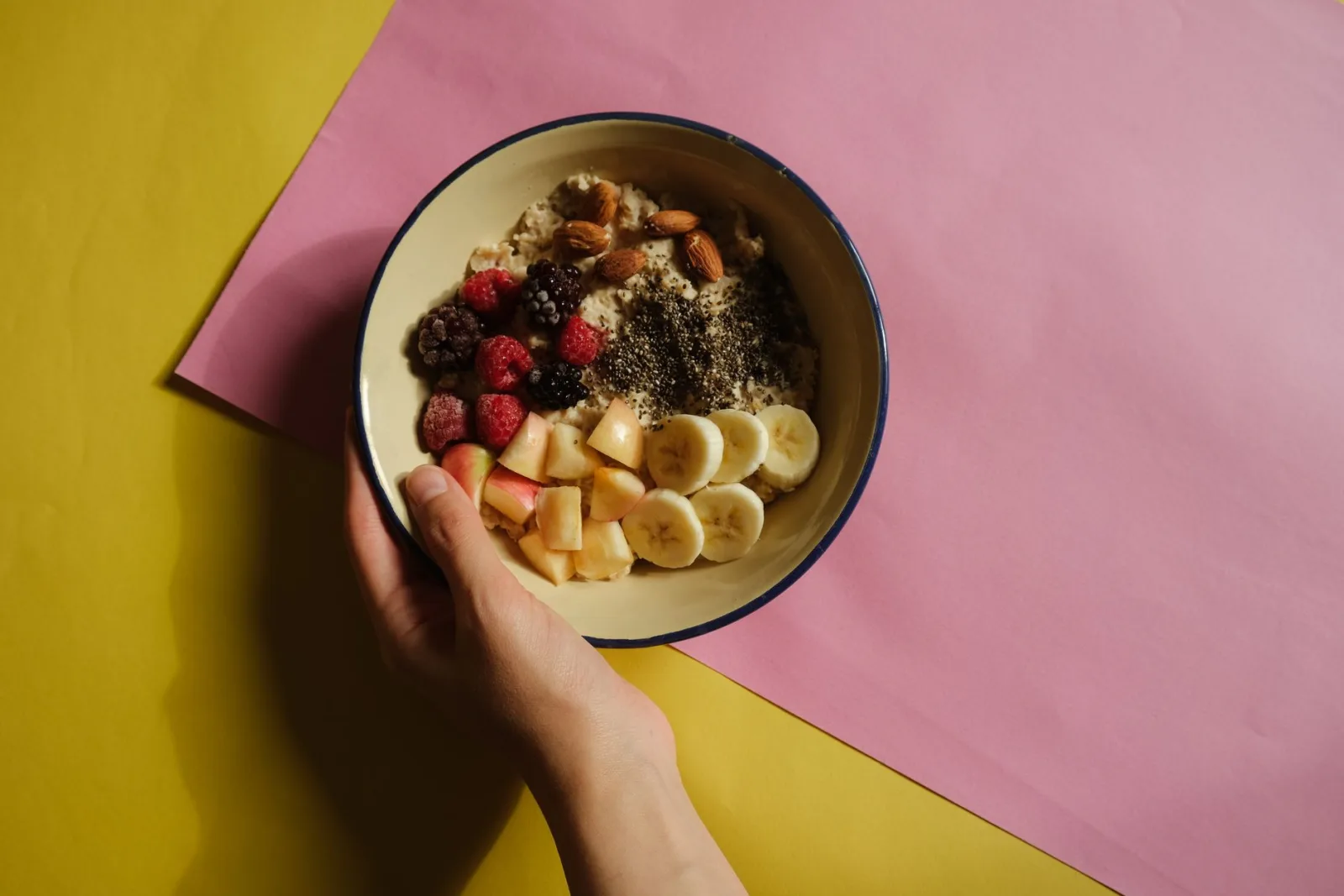
In short:
- Chia seed porridge is made with 40 g of rolled oats, 1 tablespoon of chia and 250 ml of liquid.
- The seeds absorb several times their weight: allow an extra 50 ml of liquid per spoonful.
- Two methods: hot in five minutes, or soaked overnight in the fridge, with a lower glycaemic index.
- The bowl comes to about 380 kcal, 11 g of fibre and 16 g of protein with semi-skimmed milk.
Chia seed porridge is a classic oat porridge with a spoonful of seeds added. The addition seems trivial, yet it changes the recipe: the seeds absorb liquid, thicken the bowl and make it far more filling. Without adjusting the ratios, you get a solid block instead of a porridge.
It should not be confused with chia pudding, made of seeds alone soaked in milk, which is covered in the article on chia seed benefits. Porridge keeps rolled oats as its base: it is softer, more substantial, and needs fewer seeds.
The ratios for one bowl
| Ingredient | Quantity | Role |
|---|---|---|
| Rolled oats | 40 g | the base, the binding starch |
| Chia seeds | 1 tablespoon, about 14 g | the thickener, the fibre |
| Milk or plant-based drink | 250 ml | cooking or soaking |
| Salt | 1 pinch | depth |
| Fruit | 100 g | sweetness and freshness |
The logic is easy to remember. A plain porridge is 40 g of oats for 200 ml of liquid. Each spoonful of chia absorbs about 50 ml more. Two spoonfuls of chia therefore need 300 ml.
Beyond two spoonfuls, the bowl turns into a jelly, and the fibre intake exceeds what most people tolerate comfortably at breakfast. One spoonful is the right amount to start with.
The choice of liquid changes the taste and the balance. Semi-skimmed milk gives the roundest porridge and the most protein. A plant-based drink works perfectly well, and the same trade-offs as in the dairy-free smoothie apply: soy drink keeps the protein, almond drink lightens the bowl, oat drink makes it sweeter.
The hot version, in five minutes
- Bring the liquid to a simmer with the pinch of salt.
- Add the oats and cook for four to five minutes over low heat, stirring now and then.
- Take off the heat, then add the chia seeds. Cooking them with the oats makes them slimy and sticky at the bottom of the pan.
- Stir, wait two minutes, stir again. This second stir is what prevents clumps of seeds.
- Leave to rest for five minutes, covered, while the gel forms.
The porridge should slide slowly off the spoon. If it holds as a block, add hot liquid a spoonful at a time.
The overnight version, no cooking
This is the most practical format on weekdays, often called overnight oats.
- Mix in a jar the oats, seeds, liquid and salt.
- Stir after ten minutes, once the seeds have started to swell. Without this step, they sink and form a solid layer.
- Close and refrigerate for at least eight hours.
- In the morning, loosen with two spoonfuls of liquid if needed, add the fruit, and eat cold or warmed for a minute.
This version has a real nutritional advantage. Oats soaked cold keep a lower glycaemic index than cooked oats, because cooking makes starch more quickly absorbed. The mechanism is explained in the article on the low GI breakfast.
What the bowl adds up to
For 40 g of oats, one spoonful of chia, 250 ml of semi-skimmed milk and 100 g of fruit:
| Element | Calories | Fibre | Protein |
|---|---|---|---|
| 40 g rolled oats | about 150 kcal | 4 g | 5 g |
| 14 g chia seeds | about 68 kcal | 5 g | 2.3 g |
| 250 ml semi-skimmed milk | about 115 kcal | 0 g | 8.3 g |
| 100 g fruit | about 50 kcal | 2 g | 0.5 g |
| Total | about 380 kcal | 11 g | 16 g |
The 11 g of fibre is more than a third of the recommended 30 g a day. That is what gives this breakfast its staying power: it keeps you full far longer than a bowl of cereal of the same weight.
With unsweetened almond drink, the bowl drops to around 320 kcal, but protein falls to about 9 g. With whole milk, it goes past 430 kcal.
Toppings, and what they add
Plain porridge is bland, that is its job: it carries what goes on top.
- Fresh fruit: banana, grated apple, berries, pear. Banana mashed into hot porridge is often enough to replace any sugar.
- Nuts: a handful of almonds or walnuts, about 15 g, adds crunch and around a hundred kcal.
- Seeds: pumpkin, sunflower, one spoonful is enough.
- Sweetener: a teaspoon of honey or maple syrup provides around twenty kcal, a tablespoon around sixty. It is the addition that gets out of hand fastest.
- Spices: cinnamon, cardamom or vanilla give an impression of sweetness without sugar.
A little homemade granola on top brings the crunch porridge lacks, as long as it stays at one tablespoon: it is the most calorific topping on the list.
The mistakes that ruin chia seed porridge
- Keeping the ratios of a plain porridge. The seeds absorb the liquid and the bowl turns solid.
- Cooking the seeds with the oats. They turn slimy and stick.
- Not stirring after a few minutes. The seeds clump into gelatinous lumps.
- Swallowing dry seeds scattered on at the last moment, with no time to hydrate. That is the main precaution with chia, even in small amounts.
- Piling on sugar. A porridge with two spoonfuls of honey and a handful of granola goes past 550 kcal and loses most of its point.
For a gluten-free breakfast, the oats must carry the label, otherwise they may be contaminated, as the article on the gluten-free breakfast explains. Chia seeds are naturally free of it.
Home versus coffee shop
A topped bowl of porridge commonly sells for 8 to 10 euros in coffee shops and at brunch. At home, 40 g of oats, a spoonful of chia, 250 ml of milk and a piece of fruit cost under one euro. Prepared in three jars on Sunday evening, it covers three weekday mornings for ten minutes of work.
Frequently asked questions
What are the ratios for chia seed porridge?
For one bowl: 40 g of rolled oats, one tablespoon of chia seeds, about 14 g, and 250 ml of milk or plant-based drink. That is the ratio of a classic porridge, 40 g of oats for 200 ml, plus about 50 ml of liquid for each spoonful of chia, because the seeds absorb several times their weight.
Does chia seed porridge need cooking?
No, it is a choice. Hot, the oats cook for five minutes in the liquid and the seeds go in off the heat, followed by five minutes’ rest. Cold, everything soaks overnight in the fridge and is eaten as it is or warmed up. The cold version keeps a lower glycaemic index, because the starch in the oats is less transformed by cooking.
How long should chia seeds swell in porridge?
Ten minutes at least for the gel to form, and overnight for a properly set texture. In the hot version, five minutes’ rest off the heat is enough, since heat speeds up absorption. The step that matters is stirring once after two or three minutes: otherwise the seeds clump together at the bottom of the bowl.
How long does chia seed porridge keep?
Three days in the fridge, in closed jars, without the fresh fruit or nuts, which go on at serving time. The porridge thickens as it waits: two or three tablespoons of liquid bring it back to the right texture. That is what makes it one of the few breakfasts that can be prepared for several days.
How many calories are in chia seed porridge?
About 380 kcal for a bowl of 40 g of rolled oats, one spoonful of chia, 250 ml of semi-skimmed milk and 100 g of fruit. With unsweetened almond drink instead of milk, the bowl drops to around 320 kcal, but loses nearly half its protein. Toppings make the difference: a handful of almonds adds 100 kcal, a spoonful of honey around sixty.