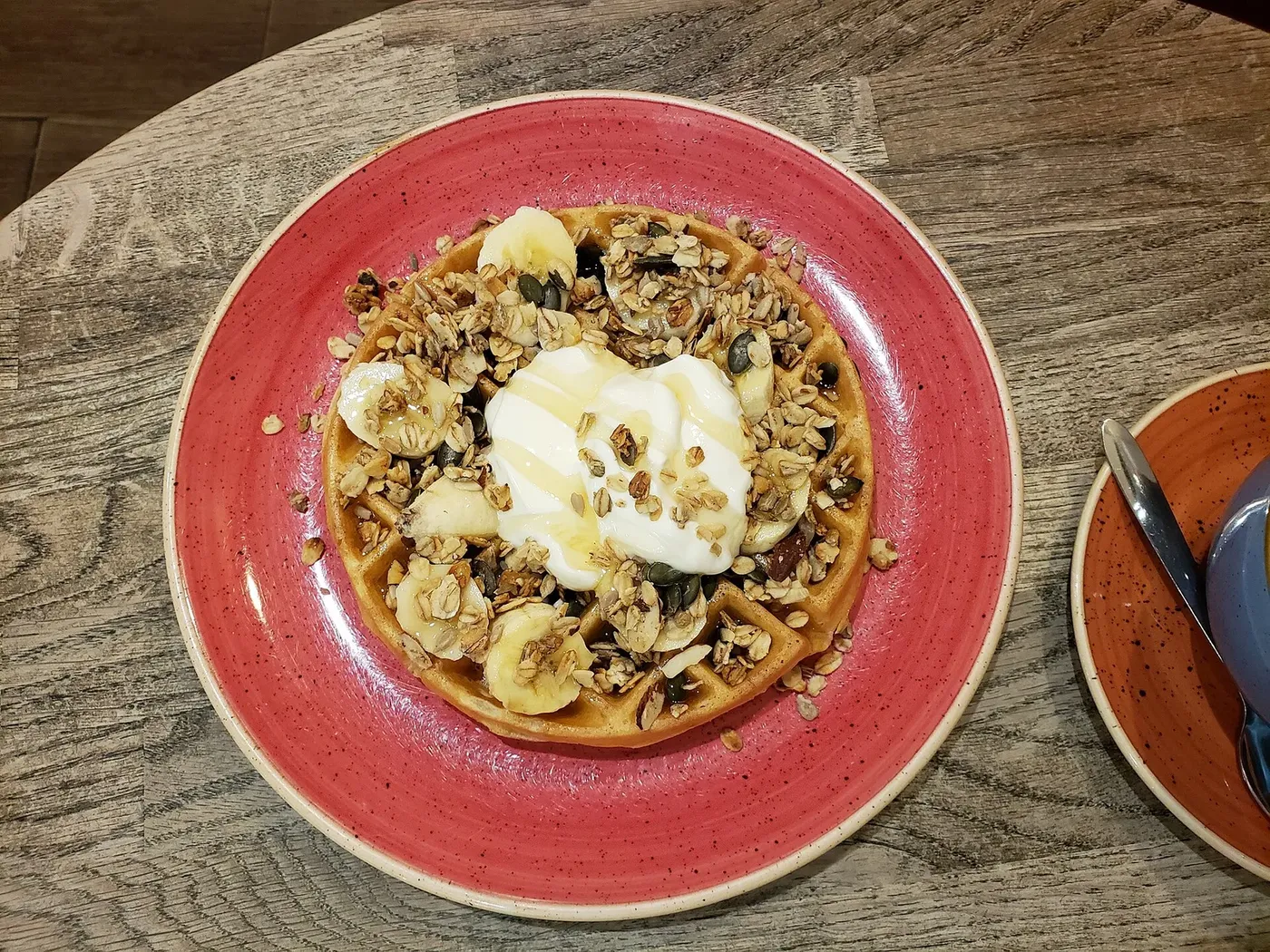
In short:
- Crispness comes from cornflour, butter and a properly hot iron.
- Fluffiness comes from whipped egg whites, folded in last, and from resting the batter.
- Never stack waffles. They go soft under their own steam within two minutes.
- The batter is made the night before, the whites are whipped in the morning.
Crisp and fluffy waffles do not need a different recipe from any other, they need two opposite goals handled at once. Crispness is a matter of a dry surface, fluffiness a matter of trapped air. The recipes that fail are the ones that play on only one of the two.
Why a waffle goes soft
Before the proportions, this mechanism explains half the failures.
A waffle coming off the iron is saturated with water as steam. It keeps releasing it for several minutes. As long as that steam escapes, the crust stays dry and crisp. The moment it is trapped, it condenses back into the crust and soaks it from the inside.
That is exactly what happens when waffles are stacked as they come, or laid flat on a cold plate. The best batter in the world does not survive that move.
The proportions, for about eight waffles
| Ingredient | Quantity | Role |
|---|---|---|
| Plain flour | 200 g | the structure |
| Cornflour | 50 g | the dry crust |
| Baking powder | 2 teaspoons | even air pockets |
| Sugar | 2 tablespoons | colouring |
| Salt | 1 pinch | flavour |
| Eggs | 3, whites and yolks separated | binding and air |
| Whole milk | 400 ml | hydration |
| Melted butter | 100 g | flavour and crispness |
The ratio to remember is the cornflour, about a fifth of the total flour weight. It is the most effective and least known lever: cornflour holds less protein than wheat flour, so develops less gluten and retains less water at the surface.
Butter is not negotiable. At this quantity it does more than add flavour: it takes the place of water in the crust and contributes directly to crispness. Oil does not give the same result.
The three levers of crispness
Cornflour
Replacing 50 g of flour with 50 g of cornflour visibly changes the crust without altering the inside. It is the most profitable change that can be made to a classic recipe.
A genuinely hot iron
The iron must have reached temperature before the first ladle, which often takes longer than the indicator light suggests. A lukewarm plate cooks the waffle slowly, lets the water evaporate gently and produces a pale, limp waffle. A hot plate sears the surface immediately.
The first waffle is almost always a write-off. That is normal: it finishes heating the plates.
Butter, not oil
Beyond flavour, butter contains water that evaporates during cooking and leaves a drier structure. It also colours better, thanks to the milk proteins it carries.
The two levers of fluffiness
Whipped egg whites
This is the move that separates a dense waffle from an airy one. Whipped whites bring air bubbles that expand in the heat and create the open interior.
Three precautions:
- Whip the whites firm but not dry. Over-whipped, they fold in badly and leave white lumps.
- Fold them in last, with a spatula, lifting the mass. A whisk breaks them.
- Fold them in just before cooking, never before a rest, or they collapse and the work is lost.
Baking powder does not replace the whites, and the whites do not replace baking powder. The powder gives even pockets throughout the thickness, the whites give lightness. Together they produce the contrast being sought.
Resting the batter
Thirty minutes is enough, a night in the fridge is better. During that time the flour hydrates fully and the gluten network formed during mixing relaxes. The waffle comes out more tender and less rubbery.
It is the same principle as for pancakes, where resting is the most underrated factor: the detail is in the article on light pancakes. For a version without baking powder, relying on whipped whites alone, the recipe for pancakes without baking powder applies exactly the same logic.
Cooking
- One ladle per mould, no more. The batter swells, and a waffle that overflows cooks badly at the edges.
- Do not open before the end. Opening mid-cook releases the steam that lifts the waffle, and it collapses.
- Trust the steam, not the timer. As long as the iron is steaming heavily, the waffle is not ready. When the steam clearly drops off, it is.
- Count three to five minutes depending on the machine, bearing in mind that times vary widely between irons.
Serving, where it all gets lost
This is the step nobody addresses, and it undoes everything else.
- Set each waffle on a rack, never on a plate, and never one on another.
- To serve a batch, hold the waffles in the oven at 90 °C, on the rack, door ajar. Dry heat keeps the crust, the open door lets the moisture leave.
- Top at the last moment. A wet topping sitting five minutes ahead soaks through the crust.
That constraint makes waffles the trickiest dish to slot into a service for several. They cook in waves and go out immediately, which places them at the end of the sequence: the full order is set out in the breakfast tray.
To drink alongside, something cold works better than a sweet juice, which doubles up on the sugar of the topping. The proportions are in how to make a smoothie.
Frequently asked questions
How do you get waffles crisp outside and fluffy inside?
The contrast rests on three moves: whipping the egg whites and folding them in last, which gives the soft interior, replacing part of the flour with cornflour, which dries the crust, and cooking in a properly preheated iron. The fourth move is serving: a waffle laid flat on a plate or stacked goes soft within two minutes under its own steam.
Why do my waffles go soft?
Because they are stacked or laid flat. A waffle coming off the iron keeps releasing steam for several minutes. Trapped under another waffle or pressed against a plate, that steam cannot escape and soaks the crust from the inside. Setting them on a rack, never one on top of another, is enough to solve it.
Should waffle batter rest?
A rest of at least thirty minutes, ideally overnight in the fridge, genuinely improves the texture: the flour hydrates fully and the gluten network relaxes, giving a more tender waffle. If the whites are whipped, they are folded in just before cooking and not before the rest, otherwise they collapse.
Which flour is best for waffles?
An ordinary plain flour is fine. The real lever is not the type of flour but replacing about a fifth of its weight with cornflour, which holds less protein and gives a markedly drier, crisper crust.
Can waffle batter be made the night before?
Yes, and it is even recommended for the base. The batter without the whites keeps overnight in the fridge in a sealed container. The whites are whipped and folded in during the morning, just before cooking. It is the preparation best suited to brunch, since it shifts most of the work to the night before.