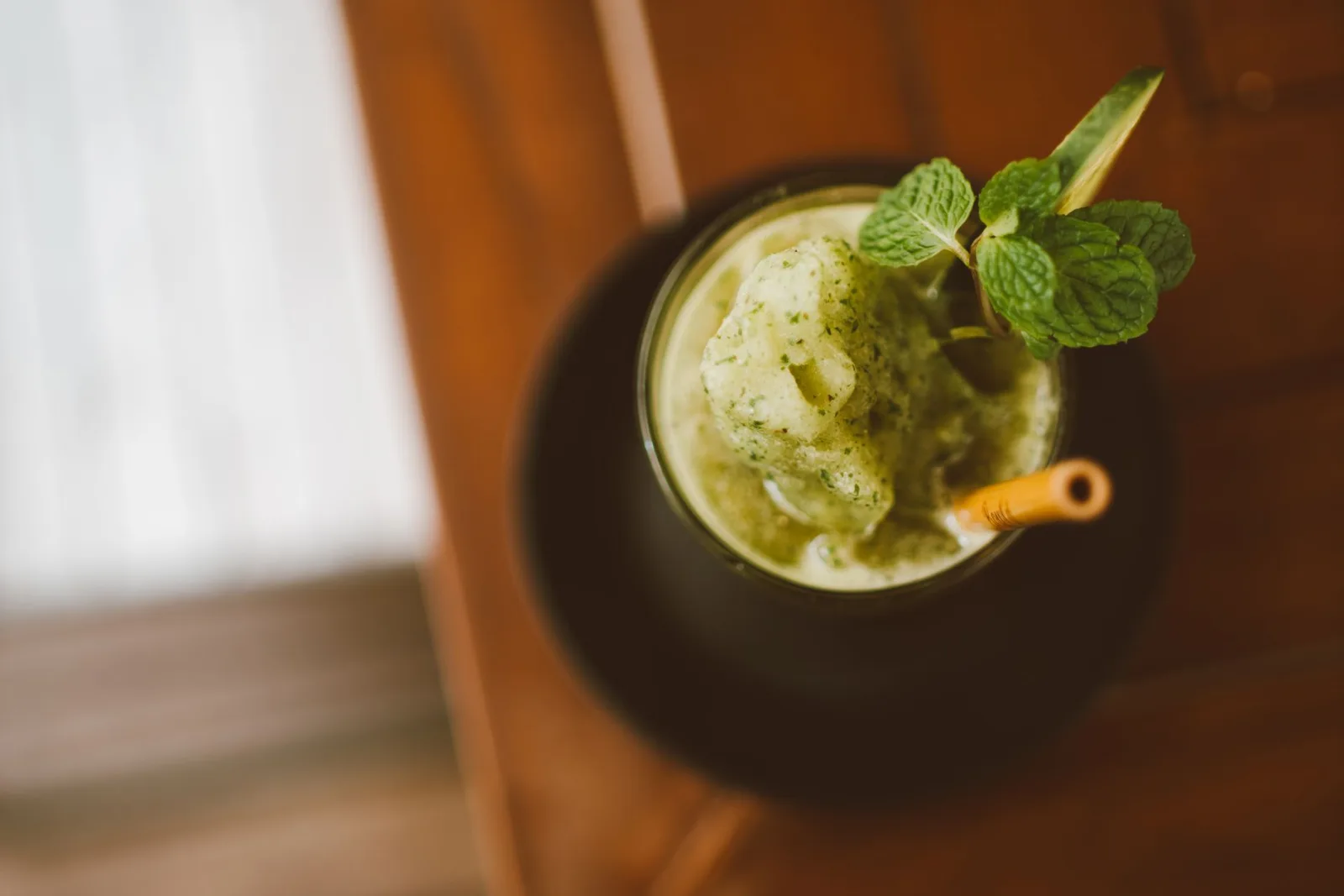
In short:
- Cucumber is 96 % water: drop the added liquid to 50 ml instead of the usual 150 ml.
- Keep the skin on a Dutch cucumber, remove it on a field-grown one, which is more bitter.
- With no fat or protein base, the mixture separates within minutes.
- The glass comes to around 120 kcal, against 250 for a fruit smoothie of the same size.
A cucumber smoothie almost always fails in the same way: it comes out bland, thin, and separates before you have finished it. This is not a recipe problem, it is a physics problem. A cucumber holds more water than a watermelon, and most recipes still apply fruit-smoothie ratios to it.
The ratios, corrected for the water
The general ratios for a smoothie rest on a fruit-to-liquid rule of 200 to 150. Applied to cucumber, that rule gives you a glass of green water.
Here is what works for a 350 ml serving:
| Element | Amount | Role |
|---|---|---|
| Cucumber | 150 g, about a third of one | the volume and the freshness |
| Creamy base | 80 g | the hold, nothing works without it |
| Sweet fruit | 100 g | the flavour, cucumber has almost none |
| Added liquid | 50 ml maximum | to help the blender, nothing more |
| Acid | 1 tablespoon | the lift |
The number to remember is 50 ml of liquid, against 150 ml for a standard smoothie. Often you can go down to none at all if the blender is powerful enough to pull the cucumber through on its own.
The skin, which decides the bitterness
This is the point recipes contradict each other on most, because they are talking about different cucumbers.
Cucumber bitterness comes from cucurbitacins, compounds concentrated in the skin and in the two centimetres closest to the stem. Their level varies enormously between varieties and growing conditions: a cucumber that has been short of water contains far more of them.
The long Dutch cucumber, the shrink-wrapped one sold in every supermarket, has been bred to contain very little. Its skin can be kept without hesitation: it gives the smoothie its bright green, which turns a dull khaki if you peel it.
A knobbly field-grown cucumber, on the other hand, is worth tasting raw before blending. A piece of skin that is frankly bitter in the mouth will give an undrinkable smoothie, because blending spreads that bitterness through the whole glass.
In every case, cut off and discard the two centimetres at the stem end. That is where everything concentrates, and it costs you almost nothing.
The seeds, keep or remove
In a young cucumber the seeds are soft and invisible once blended, so they stay. In a large end-of-season cucumber they are hard and full of water. Scraping them out with a spoon takes thirty seconds and removes a meaningful share of the water problem.
Why it separates, and what stops it
A smoothie holds because something is retaining the water: fruit fibre, a protein, a fat. Cucumber supplies neither protein nor fat, and its fibre is far too sparse to structure anything.
Three bases work, in different registers:
- Greek yoghurt, 80 g. The most neutral answer, the one that leaves the cucumber flavour in front. It also brings 8 g of protein, which changes how filling the glass is.
- Half an avocado. The thickest texture, creamy to the point of approaching a chilled soup. It does mute part of the cucumber flavour.
- Half a banana. It holds well but imposes its sugar and its scent, turning the result into a faintly green banana smoothie.
Without one of the three, the mixture separates in five to ten minutes, exactly like a home-made vegetable juice.
The pairings that work
Cucumber cannot carry a smoothie on its own: it brings freshness, not flavour. It needs a sharp partner.
Green apple and lime. The most reliable pairing. The acidity of the green apple wakes the cucumber up, and the lime fixes the colour by slowing oxidation. This is the one to try first.
Fresh mint, five or six leaves only. Any more and it flattens everything else. Mint goes in last, for fifteen seconds, otherwise it blackens.
Fresh ginger, 3 g, about the size of a small coin. It supplies the bite that is missing and pairs very well with cucumber, provided it stays discreet.
Fresh spinach, 30 g. It deepens the green without being tasted. It is the most useful addition if the aim is a low-GI breakfast, since it contributes no sugar at all.
What does not work: red berries, whose pigment turns a dirty brown against the green. It is the same mechanism as the colour problem in a berry smoothie, only worse, because the two shades cancel each other out.
Salt, which surprises people and works
A pinch of salt in a cucumber smoothie brings out the vegetable rather than making it salty. It is the same principle as salt in a dessert, and it is what separates a bland cucumber smoothie from one with character. A quarter of a teaspoon, no more.
Blending, briefly
Thirty to forty-five seconds is enough. Beyond that, two things happen: the mixture warms slightly, which is always a shame in a cold drink, and it foams. That foam never settles and makes the glass look half empty.
If the blender struggles, the right response is not to add water but to shake the jug or work in two batches. Every spoonful of water takes you further from the result you were aiming at.
What it actually comes to
A 350 ml glass with cucumber, green apple, Greek yoghurt and lime:
| Element | Amount |
|---|---|
| Energy | around 120 kcal |
| Sugars | 12 to 14 g, only from the apple and the yoghurt |
| Protein | 7 to 8 g with Greek yoghurt |
It is the lightest blended drink you can put together, and the only one that stays under 15 g of sugars without any trickery. A fruit smoothie of the same volume runs at about 250 kcal and 30 g of sugars.