In short:
- A dairy-free smoothie keeps the same ratio: 250 g of fruit for 120 to 150 ml of liquid.
- Creaminess does not come from milk but from frozen fruit: a frozen banana or mango does most of the work.
- Water is the best substitute for flavour, soy drink the only one for protein.
- The trap: fruit juice as the liquid, which doubles the sugars and adds nothing to texture.
A dairy-free smoothie does not call for a different recipe. It calls for understanding what the milk was doing in the glass, so as to replace it in the right place. Milk brings a little liquid, a lot of roundness, and its proteins help the mixture hold. Without it, the risk is not failure, it is a smoothie that is more watery and more acidic.
The reasons to go without vary: no milk left in the fridge, lactose intolerance, a plant-based diet, or simply wanting a fresher smoothie. The method is the same in every case.
The ratio does not change
The base remains the standard one from how to make a smoothie, for a large 400 ml glass:
| Element | Quantity | Role |
|---|---|---|
| Fruit, half of it frozen | 250 g | body, flavour and cold |
| Milk-free liquid | 120 to 150 ml | makes blending possible |
| Creamy element | 40 to 80 g | replaces the roundness of milk |
| Acid, optional | 1 tablespoon of lemon juice | lift |
One adjustment only: the more neutral the liquid, the lower in the range you stay. With water, 120 ml is enough. With a plant-based drink, which has a little body, you can go up to 150 ml.
What to use instead of milk
Each liquid changes the flavour, the texture and the balance of the glass. Values for 150 ml, the amount for one smoothie:
| Liquid, 150 ml | Calories | Effect on flavour | Key point |
|---|---|---|---|
| Water | 0 kcal | masks nothing | the cleanest choice, with ripe fruit |
| Coconut water | about 30 kcal | light sweetness | works with tropical fruit |
| Unsweetened almond drink | 25 to 40 kcal | discreet plant note | lets the fruit’s acidity through |
| Plain soy drink | 50 to 65 kcal | round, slightly pronounced | the only one rich in protein, about 5 g |
| Plain oat drink | 60 to 90 kcal | sweet, cereal-like | the closest to milk in texture |
| Orange juice | about 65 kcal | tangy and sweet | doubles the sugars in the glass |
| Apple juice | about 70 kcal | very sweet | the liquid of commercial smoothies |
For comparison, the same 150 ml of semi-skimmed milk provides about 70 kcal. Values for plant-based drinks vary by brand, the detail is in the article on café au lait calories, and the label is what counts: a drink labelled “original” often contains added sugar.
The case of apple juice was already covered in the berry smoothie article: it is the ingredient that lets commercial bottles stretch the glass cheaply. Used at home instead of milk, it has the same effect.
Creaminess without dairy
This is the real question of the dairy-free smoothie. The answer fits in one rule: creaminess comes from dense fruit and from cold, not from the liquid.
- Frozen banana, half to a whole one. The most effective option, giving a texture close to ice cream. It imposes its flavour, which is rarely a problem.
- Frozen mango. Almost as creamy as banana, with a stronger, more acidic taste.
- Avocado, half of one, about 60 g. A powerful, neutral-tasting thickener, best kept for green smoothies.
- Rolled oats, 20 g. They thicken and fill you up, as long as you blend for at least a minute so they cannot be felt.
- Chia seeds, one tablespoon. They thicken the glass in about ten minutes thanks to their mucilage, explained in the article on chia seed benefits.
- A nut butter, one tablespoon of peanut butter or almond butter. It brings the fatty roundness of whole milk.
- Silken tofu, 80 g. Undetectable in taste, it gives a yogurt-like creaminess and adds 4 to 5 g of protein.
A plant-based yogurt, soy or coconut, plays the same role. Just check that it is not sweetened, which many are.
Four dairy-free recipes that hold together
Each line makes a large glass of about 400 ml.
| Recipe | Fruit | Liquid | Creamy element | Calories |
|---|---|---|---|---|
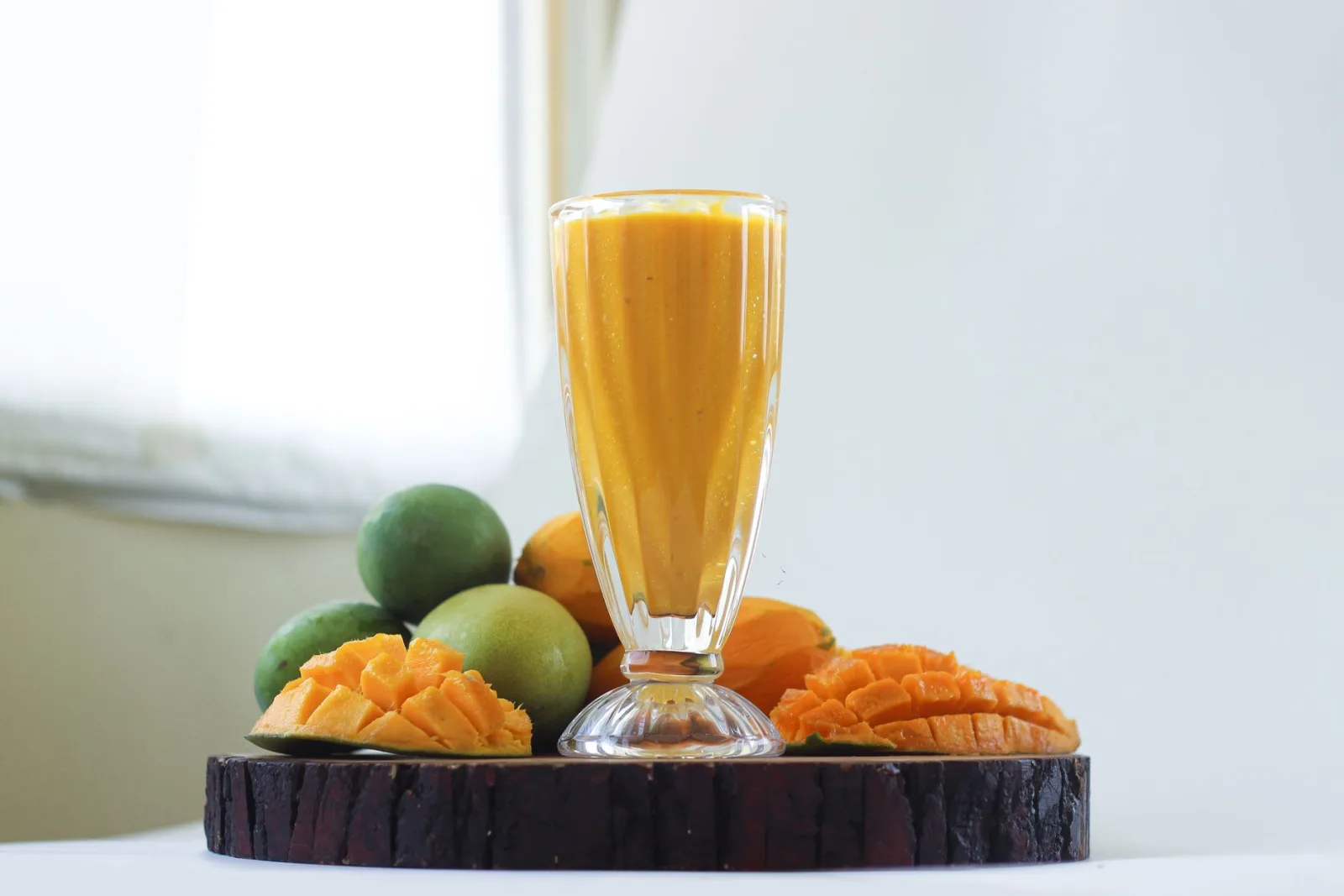
| Mango and coconut | 200 g frozen mango, 50 g banana | 140 ml coconut water, juice of half a lime | the mango is enough | about 190 kcal |
| Berries and oats | 150 g frozen berries, 100 g banana | 130 ml water | 20 g rolled oats | about 225 kcal |
| Banana and peanut | 200 g frozen banana | 150 ml soy drink | 1 tablespoon peanut butter | about 330 kcal |
| Green pineapple | 150 g frozen pineapple, 30 g fresh spinach | 120 ml water, juice of half a lemon | half an avocado | about 180 kcal |
The banana and peanut version is the most filling, with around ten grams of protein: it replaces a breakfast, not just a drink. The other three go alongside a meal.
Mistakes specific to dairy-free smoothies
- Replacing milk with too much water. The most frequent mistake. Beyond 150 ml, the glass tips towards diluted juice, and water cannot fix it.
- Using only fruit juice. The smoothie becomes a very sweet drink with no gain in texture.
- Confusing coconut water and coconut milk. Canned coconut milk contains 15 to 20% fat and provides around 180 kcal per 100 ml, nearly three times whole milk. A tablespoon adds roundness, no more.
- Forgetting the acid. Without milk to round things off, a smoothie made with sweet fruit turns flat. A squeeze of lemon wakes up the glass.
- Blending only fresh fruit. Without a frozen element, a dairy-free smoothie comes out lukewarm and runny. Cold makes thickness, not ice cubes, which dilute.
Dairy-free does not mean protein-free
A smoothie made of fruit and water provides 2 to 3 g of protein, next to nothing. That is what makes it unsatisfying: it is digested within an hour.
To make it last until lunch, three dairy-free additions make the difference: soy drink instead of water, about 5 g of protein per glass, silken tofu, 4 to 5 g for 80 g, and nut butter, 3 to 4 g per spoonful. Combined, they reach 12 to 15 g, the level of a smoothie made with Greek yogurt.
It is also the test for judging a “vegan” smoothie sold for 7 or 8 euros at a brunch counter: if the list stops at fruit and juice, it is a sweet drink, not a breakfast.
Frequently asked questions
What can replace milk in a smoothie?
Water, coconut water, fruit juice or a plant-based drink, in the same volume, 120 to 150 ml for 250 g of fruit. Water is neutral and weighs nothing, coconut water adds a light sweetness, juice sweetens heavily, and soy drink is the only one close to milk in protein. Creaminess does not come from the liquid but from the fruit and thick additions.
How do you make a smoothie creamy without milk or yogurt?
With a frozen banana, the most effective option, or half a frozen mango. Half an avocado, 20 g of rolled oats, a tablespoon of nut butter or 80 g of silken tofu also give a thick texture. Cold matters as much as the ingredient: a smoothie made with frozen fruit is always thicker than the same recipe with fresh fruit.
Can you make a smoothie with water?
Yes, on two conditions. Stay at the low end of the range, 120 ml for 250 g of fruit, because water brings no texture. And use ripe, partly frozen fruit, which provides flavour and body. With bland, fresh fruit, a water-based smoothie tastes diluted.
Is a dairy-free smoothie lower in calories?
Only if the milk is replaced with water, coconut water or unsweetened almond drink. Replacing 150 ml of semi-skimmed milk, about 70 kcal, with the same amount of orange juice barely changes the calories but doubles the sugars. And canned coconut milk, often confused with coconut water, carries nearly three times as many calories as whole milk.
How long does a dairy-free smoothie keep?
Ideally it is drunk within twenty minutes. Without dairy proteins to stabilise the mixture, it tends to separate faster than a yogurt smoothie, and the fruit oxidises. In the fridge, in a closed bottle filled to the brim, it lasts a few hours while losing some colour. Shake it before drinking.