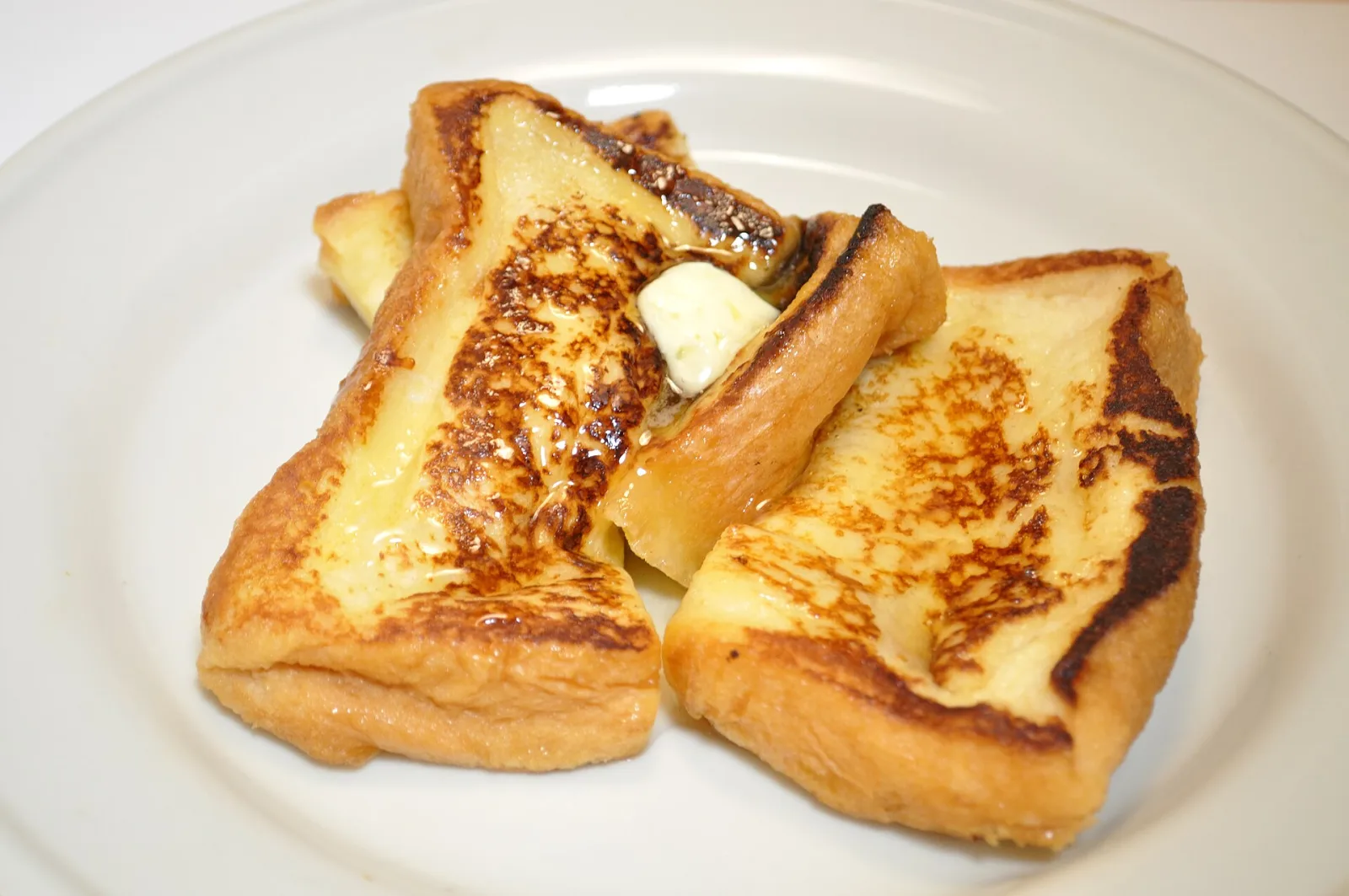
In short:
- The egg works as a binder, not as flavour: one tablespoon of cornflour replaces it.
- Thick-cut stale bread becomes the element holding everything, and is no longer negotiable.
- Soaking drops to thirty seconds per side, against several minutes in the classic version.
- Cooking runs gentler and longer, since nothing coagulates to set the surface.
Eggless French toast is often presented as a downgraded version of the classic, reserved for allergies. That reads it wrong: the egg contributes almost nothing to the flavour of French toast, it contributes a function. Once that function is understood, the eggless version comes down to two settings.
What the egg actually does
In the classic recipe, the egg plays three roles of unequal importance.
It binds. Its proteins coagulate around 65 °C and set the custard the bread is soaked in. That is what creates the thin set layer on the surface and stops the slice falling apart in the pan. It is its essential role, and the only one that has to be replaced.
It colours. The yolk brings the pigments which, with sugar, give the characteristic golden shade.
It enriches. It adds fat and a light flavour, largely covered by sugar, vanilla or cinnamon.
The consequence is direct: eggless French toast does not need a different recipe, it needs a different binder and an adjustment in cooking.
Ratios for four slices
| Ingredient | Quantity | Role |
|---|---|---|
| Stale bread cut at 2-3 cm | 4 slices | structure |
| Whole milk or oat drink | 250 ml | soaking |
| Cornflour | 1 level tablespoon | binder |
| Sugar | 1 tablespoon | flavour and colouring |
| Vanilla or cinnamon | to taste | aroma |
| Butter or neutral oil | for the pan | colour and crispness |
The move that matters: slake the cornflour cold in two or three tablespoons of milk until smooth, then pour in the rest. Tipped straight into whole milk, it forms lumps that never dissolve and burn in the pan.
The sugar is not there only for taste. Through caramelisation it provides the golden colour the egg yolk used to bring. Leaving it out gives pale French toast.
The three binders that work
Cornflour, the default
The most neutral and the most consistent. It gels with heat, around 70 °C, and forms a film that holds the slice. One level tablespoon per 250 ml of milk is enough; beyond that, the surface turns slightly tacky to the touch.
Chickpea flour, for colour
It binds correctly and adds a distinctly golden colour, very close to what egg yolks give. Same dosage as cornflour. Its light pulse flavour disappears in cooking, as long as one tablespoon is not exceeded.
Mashed banana, for sweet versions
Half a very ripe banana mashed with a fork into the milk binds and sweetens at once. It imposes its flavour, which makes it an option rather than a neutral replacement. It also browns faster in the pan, so it needs gentler heat.
What does not work
Apple sauce comes up often in online recipes. It brings water and sugar, but no structuring starch in useful quantity: the slice stays soft in the middle and breaks on the spatula. Condensed milk thickens without binding, with the same outcome.
The bread, now the deciding element
In a classic recipe, mediocre bread is rescued by the egg. Without egg, it no longer is.
- Two to three days stale. Dry bread absorbs without disintegrating, fresh bread is already saturated with water and falls apart as soon as it meets the custard.
- Cut between 2 and 3 centimetres. A thin slice has too little crumb to hold and folds on the spatula.
- Dense crumb. Stale brioche gives the best result, followed by country loaf and milk bread. Industrial sandwich bread is the worst candidate.
Brioche deserves a mention: its richness in butter and eggs, present in the crumb itself, partly compensates for the missing egg in the custard. That is why an old-fashioned brioche recipe made at the weekend finds its second use the following Tuesday, once it has dried out.
Cooking, the second setting
This is where most eggless versions fail, because the reflexes of the classic recipe get applied.
- Soak thirty seconds per side, no more. Stale bread absorbs fast, and with no coagulating protein, excess liquid has nowhere to go.
- Heat the pan over medium, never high. Without egg, nothing sets the surface instantly: too much heat colours the outside before the inside has firmed up.
- Count three to four minutes per side, against two in the classic version. The starch needs time to gel through.
- Turn only once. Each extra turn weakens the slice.
- Use a wide spatula, and lift the whole slice rather than pinching it.
The visual cue is the same as for crisp and fluffy waffles: as long as the surface steams heavily, water is still escaping and the slice is not ready.
Toppings that hold
Eggless French toast is slightly less rich than its classic equivalent, which leaves room for toppings without becoming cloying.
- Sugar and cinnamon, dusted on as it leaves the pan, on the still-hot slice.
- Warm berries, a handful of frozen ones thrown into the pan after cooking with a spoonful of sugar, two minutes. They release a juice that replaces syrup.
- Greek yoghurt, which brings the acidity and protein the dish lacks.
- Maple syrup, to be measured: the slice is already sweetened by the custard.
Like pancakes without baking powder, this dish is cooked in batches and served immediately. In a service for several people it sits just before the cold items, whose order is covered in the breakfast tray.
Frequently asked questions
How do you make French toast without eggs?
By replacing the egg’s binding power with starch. The base is 250 ml of milk, one level tablespoon of cornflour and one tablespoon of sugar for four slices of stale bread. The cornflour is slaked in a little cold milk before joining the rest, otherwise it forms lumps. Cooking is done over gentler heat than with eggs, since nothing coagulates to set the surface.
What replaces egg in French toast?
Three binders genuinely work: cornflour, the most neutral in taste, chickpea flour, which also brings a golden colour close to that of egg yolk, and mashed banana, which binds and sweetens at once but imposes its flavour. Apple sauce, often suggested, binds poorly: it adds water without any structuring starch.
Which bread for eggless French toast?
Stale bread, two to three days old, with a dense crumb and cut thick, between 2 and 3 centimetres. Stale brioche gives the best result, followed by country loaf. Without egg, the bread alone carries the slice: fresh industrial sandwich bread falls apart in the custard, where it would have held with eggs.
Why does my eggless French toast fall apart?
Almost always because the bread is too fresh or soaked too long. Without egg, no protein coagulates to hold the slice: the starch in the custard and the structure of the stale bread do all the work. Thirty seconds per side in the custard is enough, against several minutes for a classic version.
Is eggless French toast vegan?
Not automatically, since the base recipe uses cow’s milk and is cooked in butter. It becomes vegan by swapping the milk for an oat or soy drink and the butter for a neutral oil or margarine. Oat drink is closest to whole milk in texture, soy drink brings protein that helps slightly with holding together.