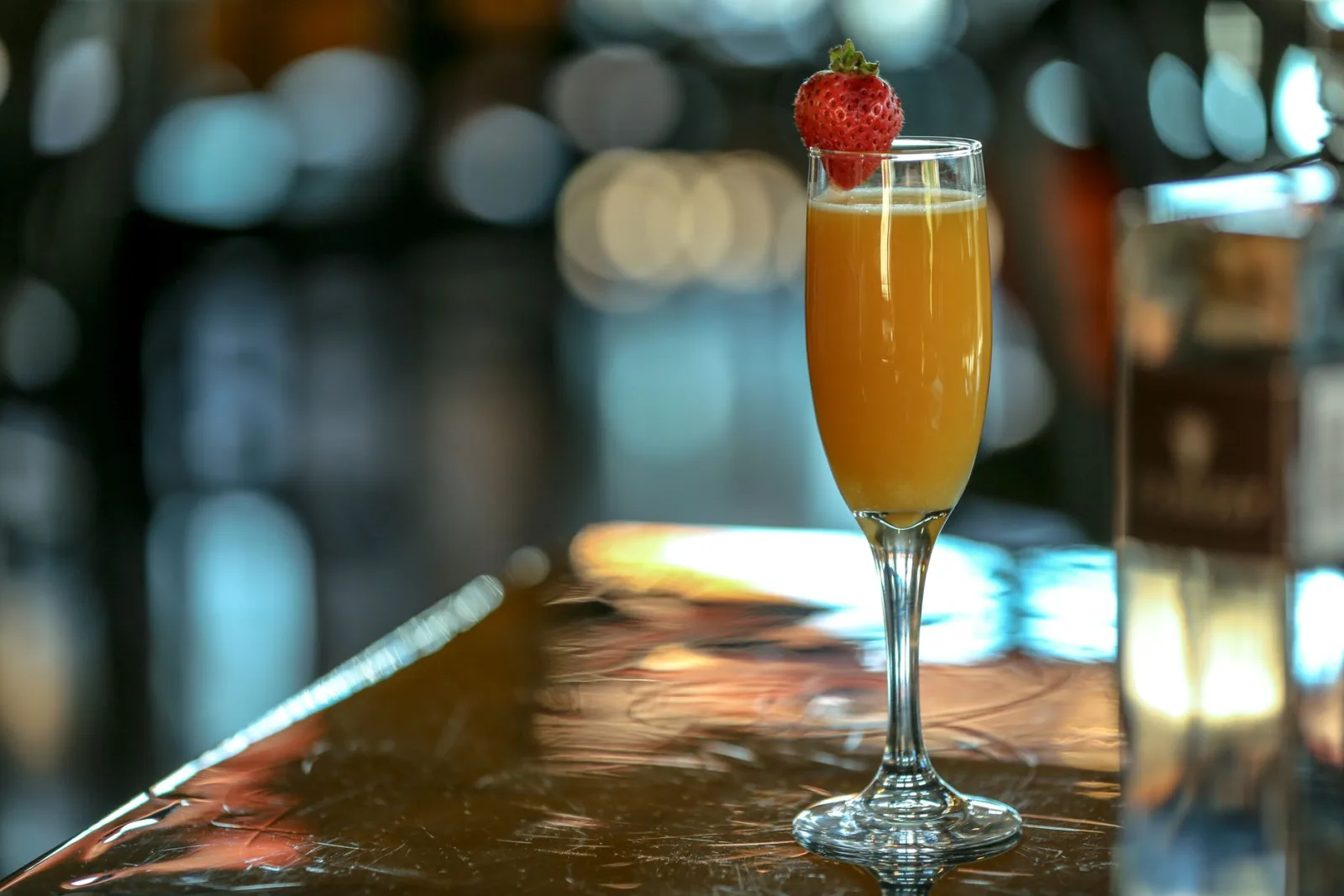
In short:
- Half and half, equal parts sparkling wine and orange juice. A buck’s fizz, by contrast, is two thirds wine.
- Sparkling wine first, juice second. The other way round, the pulp lifts the foam over the rim.
- A brut cremant is plenty. Orange juice covers the fine aromas, so a good champagne is wasted here.
- Everything at the same temperature, 4 to 6 °C, juice included. That is what holds the bubble.
The mimosa cocktail is the simplest brunch drink there is, two ingredients and no technique, which is exactly why it is so often served lukewarm, cloudy and flat. The few details that make the difference are never printed on the menu.
It is also the most profitable line on a brunch list, and it is worth knowing what is actually in the flute.
The proportions, and the buck’s fizz confusion
A mimosa is made in equal parts: as much sparkling wine as orange juice. That is the baseline, and it matches what most places serve.
The buck’s fizz is the neighbouring cocktail it is constantly confused with. It is heavier on wine, roughly two thirds sparkling to one third juice, and it came first: it was born in London in the early 1920s, a few years before the mimosa was popularised in Paris.
In practice the difference is immediate: a buck’s fizz is a faintly orange wine, a mimosa is an orange drink with a little alcohol in it. Both are defensible, but they do not play the same role on a brunch table.
| Mimosa | Buck’s fizz | |
|---|---|---|
| Sparkling wine | 50 % | about 65 % |
| Orange juice | 50 % | about 35 % |
| Impression | fruity, thirst-quenching | winey, drier |
| Approximate strength | around 6 % | around 8 % |
The pouring order, the only real technique
This is the detail that separates a clean flute from a spill on the tablecloth: wine first, juice second, slowly, down the side of the glass.
The reason is physical. Foam forms on anchor points, and the fine pulp particles suspended in orange juice make excellent ones. Pouring wine onto juice offers thousands of nucleation points at once: the foam rises instantly and overflows before the flute is half full.
In the right order, the juice falls through bubbles that are already settled without restarting them. And you do not stir. A mimosa mixes itself within seconds, and a spoon only drives the gas out.
Which sparkling wine, and why champagne is a waste
This is the choice that really matters, and it runs against the name of the drink.
Champagne is paid for its fine aromas, its complexity, its length. Orange juice covers all of it: what remains is the bubble and the acidity, which a good cremant provides just as well for three times less.
- Brut cremant (Loire, Alsace, Burgundy): the best value, made by the same method as champagne.
- Brut cava: same method, very dry, fine and persistent bubble.
- Prosecco: tank method, lighter bubble and a softer wine. Gives a distinctly sweet mimosa, for those who like that.
- Brut champagne: fine, but with no perceptible benefit once the juice is in. A vintage bottle is pure waste.
The word to look for on the label is brut, not the appellation. A demi-sec sparkling wine combined with an already sweet orange juice gives a drink that cloys before the flute is finished.
Temperature, which decides everything
A failed mimosa is almost always a lukewarm one. All three elements must be cold together:
- The wine at 4 to 6 °C, meaning three hours in the fridge, not twenty minutes in the freezer.
- The orange juice too. This is the most common mistake: room-temperature juice poured into chilled wine flattens the bubble on contact.
- The flute, five minutes in the fridge. A warm glass warms the drink from the first pour.
The flute itself is not a decorative choice: its narrow shape reduces the surface in contact with air and holds the fizz longer than a coupe. Same logic as the preheated cup in brunch coffee, where the temperature of the vessel matters as much as that of the drink.
What a flute actually costs
The sum is worth doing once, because it explains why the mimosa is on every brunch menu.
A 75 cl bottle makes about ten flutes at equal parts. With a decent brut cremant at 10 euros and a litre of orange juice at 2 euros, a flute comes to around 1.20 euros. Even with an entry-level champagne at 25 euros, it stays under 3 euros.
Sold at 9 to 14 euros, it is the most comfortable margin on the brunch list, ahead of the eggs and far ahead of the bread. That is not a reason to skip it, but it places what is being paid for: a shared bottle, a little service, and a lot of margin.
It is the same reasoning as for the whole formula, set out in what is brunch: what is expensive to produce is almost never what is charged for.
Serving a table without ruining it
A mimosa cannot be batched in a jug, it falls flat within ten minutes. What can be prepared is everything else:
- The juice strained and decanted, in the fridge, the night before.
- The bottles lying down in the cold for at least three hours.
- The flutes chilled, taken out at the last moment.
- Service in two passes: fill the glasses with wine, then go round again with the jug of juice.
Allow one bottle per five people if the mimosa accompanies the meal, one per three if it opens the table on its own. Buy generously on the juice, never on the wine: juice runs out first and is replaced in thirty seconds, unlike a bottle that has to be chilled. Quantities per person for the rest of the table are covered in the breakfast tray.
Frequently asked questions
What are the proportions of a mimosa cocktail?
The classic proportions are half and half, as much sparkling wine as orange juice. That is what separates a mimosa from a buck’s fizz, which is served at roughly two thirds wine to one third juice. Equal parts remains the standard reference in bars and at home, and it is then adjusted to the sweetness of the juice and the dryness of the wine.
Do you pour the champagne or the orange juice first?
Sparkling wine first, juice second and slowly. Poured second, the juice passes through the bubbles without making them overflow. In the opposite order, the pulp particles in the juice act as nucleation points and send foam over the rim before the flute is even full.
Can a mimosa be made without champagne?
Yes, and it is by far the most common practice. A brut cremant or a cava offers the same dryness and the same bubble retention for a third of the price, and orange juice covers the fine aromas of a champagne anyway. A prosecco also works but, being softer, it gives a noticeably sweeter cocktail.
How many mimosas does one bottle make?
A 75 cl bottle makes about ten flutes, since a half-and-half mimosa holds roughly 7 cl of sparkling wine. Allow an equivalent volume of orange juice, so around 75 cl as well, and buy generously on the juice rather than the wine.
Which orange juice works best in a mimosa?
A juice without pulp, properly chilled, gives the best result: pulp clouds the cocktail and breaks the bubble faster. Freshly squeezed juice is perfect if it is strained. The juice must be as cold as the wine, otherwise the temperature shock flattens the fizz immediately.