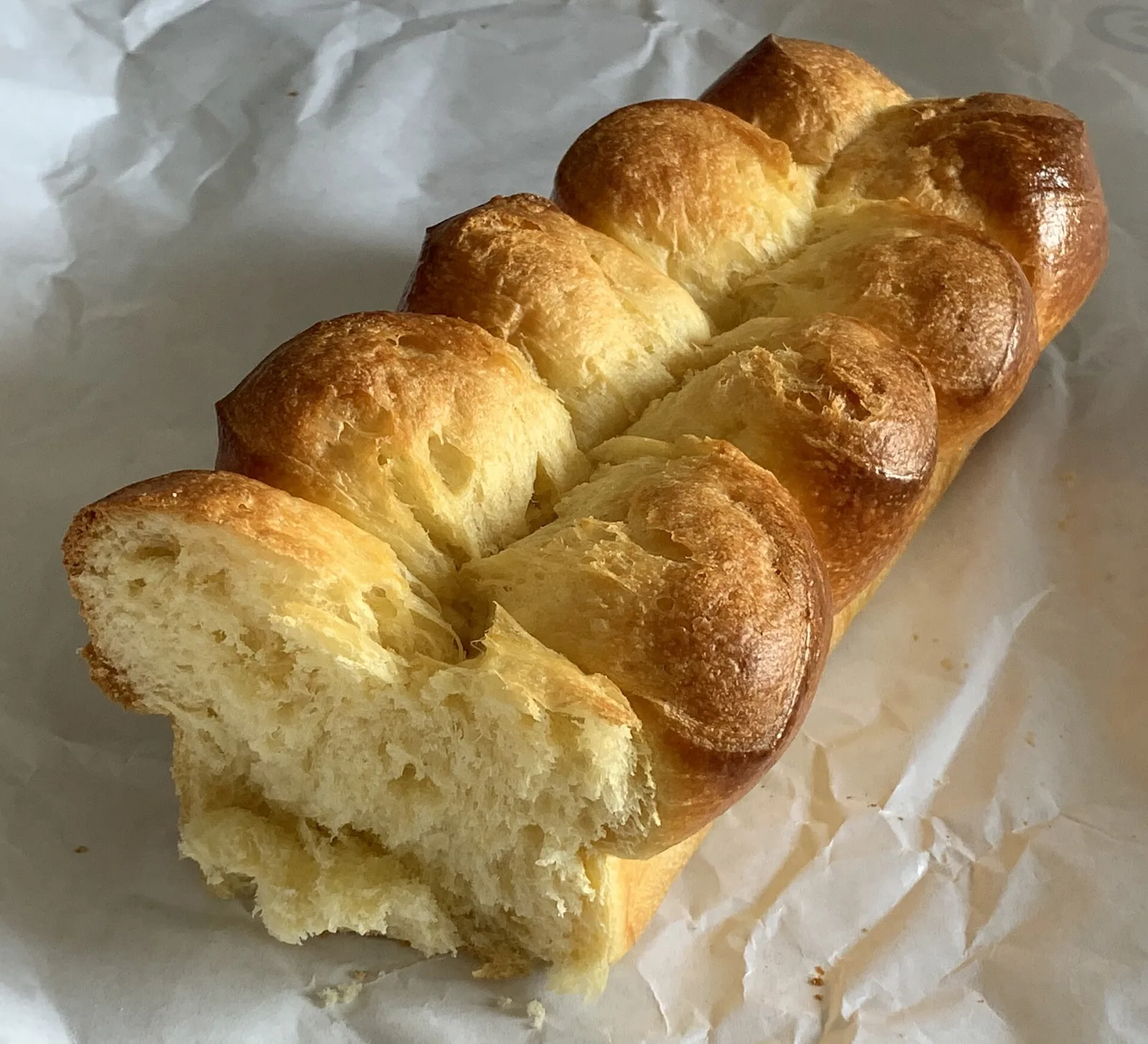
In short:
- “Old-fashioned” mostly means little yeast and a long cold rise, not a different recipe.
- The ratio to hold is 250 g of butter to 500 g of flour, or 50 %.
- The butter goes in after the gluten network is formed, never before.
- The dough spends a night in the fridge: that is the flavour, and it is also what makes it shapeable.
An old-fashioned brioche recipe is not set apart from the others by its ingredients, which are the same everywhere, but by the time it allows them. Quick recipes compensate for the missing time with three to four times the yeast, and it shows: the crumb is even but the flavour stays flat, with a pronounced yeasty note.
What “old-fashioned” means
Three concrete differences from a shop brioche or an express recipe.
Little yeast. 10 to 12 g of fresh yeast for 500 g of flour, against 30 to 40 g in quick recipes. Less yeast means slower fermentation, so more aroma produced by the yeast itself.
A long, cold rise. The dough spends a night in the fridge, between 8 and 12 hours. Cold slows gas production without stopping the reactions that create aroma.
More butter and eggs. Around 50 % of the flour weight for the butter. Below 30 %, the result is a milk bread, perfectly decent but without the texture being sought.
The ratios
Expressed in baker’s percentage, that is as a share of the flour weight, which allows the quantity to be scaled without redoing the maths.
| Ingredient | Quantity | Ratio |
|---|---|---|
| Strong or plain white flour | 500 g | 100 % |
| Whole eggs | 6, about 300 g | 60 % |
| Unsalted butter | 250 g | 50 % |
| Sugar | 60 g | 12 % |
| Fresh yeast | 10 to 12 g | 2 % |
| Salt | 10 g | 2 % |
| Milk | 2 to 3 tablespoons | depending on the flour |
Strong flour is the only ingredient worth a detour to a specialist shop. Higher in protein than ordinary plain flour, it forms a sturdier gluten network, able to carry 250 g of butter without collapsing. Plain flour works, with a slightly less stringy crumb.
Two handling rules:
- Salt and yeast do not touch while dry. Salt dehydrates yeast on direct contact. Place them on opposite sides of the bowl.
- Eggs come out ahead of time. Cold eggs cool the dough and slow the start of fermentation.
Kneading, the step that decides everything
This is where the stringy crumb is won, and the step where most homemade brioches fail.
- Mix flour, sugar, salt, yeast and eggs, without the butter. Add milk a spoonful at a time, only if the dough stays dry.
- Knead 10 to 15 minutes in a mixer, medium speed, until the dough clearly pulls away from the sides and forms a ball slapping against the bowl.
- Check with the windowpane test. Stretch a piece of dough between your fingers: it should form a translucent film without tearing. Until it does, the butter stays out.
- Add the soft butter in pieces, a third at a time, waiting for full absorption before adding the next. Count another 10 minutes.
- Watch the temperature. The dough must not go above 24 to 26 °C. Beyond that, the butter melts and weeps instead of working in. If in doubt, put the bowl in the fridge for ten minutes mid-knead.
The order is not negotiable. Butter added too early coats the flour particles and physically stops the proteins bonding to each other. The result is a crumbly, sandy crumb rather than one that pulls apart in strands.
Kneading by hand is possible but takes a good half hour and a very sticky dough to manage. It is the one case where a mixer genuinely changes the result, unlike preparations such as light pancakes, where it adds nothing.
The rise, in two stages
First rise, at room temperature, one hour. The dough should start to swell, without necessarily doubling.
Fold, then a night in the fridge. Flatten the dough to knock out the gas, fold it in three, cover it flush with cling film and leave it 8 to 12 hours in the cold. That step is what gives the recipe its name.
It has two effects, one on flavour, one on practice:
- Flavour. Fermentation aromas develop while gas production is held back by the cold.
- Handling. The butter solidifies, the dough becomes firm and shapes without sticking or extra flour. The same dough at room temperature is nearly impossible to work cleanly.
Nanterre shaping
It is the simplest and most reliable format for a homemade brioche.
- Divide the cold dough into six equal pieces, about 180 g each.
- Round each piece by rolling it under your palm, to build surface tension.
- Set them in two rows of three in a buttered loaf tin, seam down.
- Leave to rise two hours at room temperature, until the pieces touch and fill the tin.
- Glaze twice: once at the start of the rise, once again just before baking. That is what gives the even, glossy colour.
Equal weights are not about looks: uneven pieces bake unevenly and the brioche distorts in the oven.
Baking and keeping
180 °C, 25 to 30 minutes, conventional heat for preference. The brioche is done when it sounds hollow and its core reaches about 90 °C. If it colours too fast, cover it with foil halfway through.
Turn out warm, cool on a rack. Left in its tin it keeps releasing steam that soaks its base, exactly as with crisp and fluffy waffles.
It keeps two days in a tea towel or paper bag, and freezes sliced for up to three months. Comparing that with an industrial brioche lasting a week makes no sense: that shelf life comes from additives, not from a better recipe.
What to do with it after two days
A stale brioche is not a wasted brioche, it is the best raw material of the week.
- As French toast. Its crumb, rich in butter and eggs, makes it the ideal bread for the job, including in a version with no egg in the custard, covered in eggless French toast.
- Toasted, simply, with jam. A pass through the toaster makes the crumb soft again for a few minutes.
- On a morning spread, in thick slices, where it comfortably replaces pastries bought the day before. Its place in the service order is covered in the breakfast tray.
To drink alongside, a thick hot chocolate stands up to a heavily buttered crumb better than a long coffee, and the method is in hot chocolate from scratch.
Frequently asked questions
What is an old-fashioned brioche?
It is a brioche made with little yeast and a long cold rise, often a whole night, as opposed to quick recipes that make up for the missing time with three to four times the yeast. That slowness develops fermentation aromas and gives the characteristic stringy crumb. The make-up is also richer in butter and eggs, around 40 to 50 % of the flour weight for the butter.
What are the ratios for an old-fashioned brioche?
For 500 g of strong or plain white flour: 6 eggs, roughly 300 g, 250 g of butter, 60 g of sugar, 10 g of salt and only 10 to 12 g of fresh yeast. The eggs make up most of the liquid, with at most two or three tablespoons of milk added. It is the butter to flour ratio, here 50 %, that separates a real brioche from an enriched milk bread.
Why is my brioche not stringy?
In the large majority of cases, the gluten network was not developed enough before the butter went in. The dough has to be kneaded until it clearly pulls away from the bowl and can be stretched into a translucent windowpane before any butter is added. Put in too early, butter coats the flour and stops that network forming, which gives a sandy rather than stringy crumb.
Does brioche dough need a night in the fridge?
It is what separates a decent brioche from a good one. Cold slows the yeast without stopping the aromatic reactions, which gives fermentation aromas time to develop. The second benefit is mechanical: a cold dough firmed up by solidified butter shapes without sticking, while the same dough at room temperature is hard to handle.
How long does homemade brioche keep?
Two days at room temperature in a tea towel or paper bag, against a week or more for an industrial brioche containing preservatives. It freezes very well, sliced, for up to three months. Past two days it is not wasted: it is the best possible bread for French toast, precisely because it has dried out.