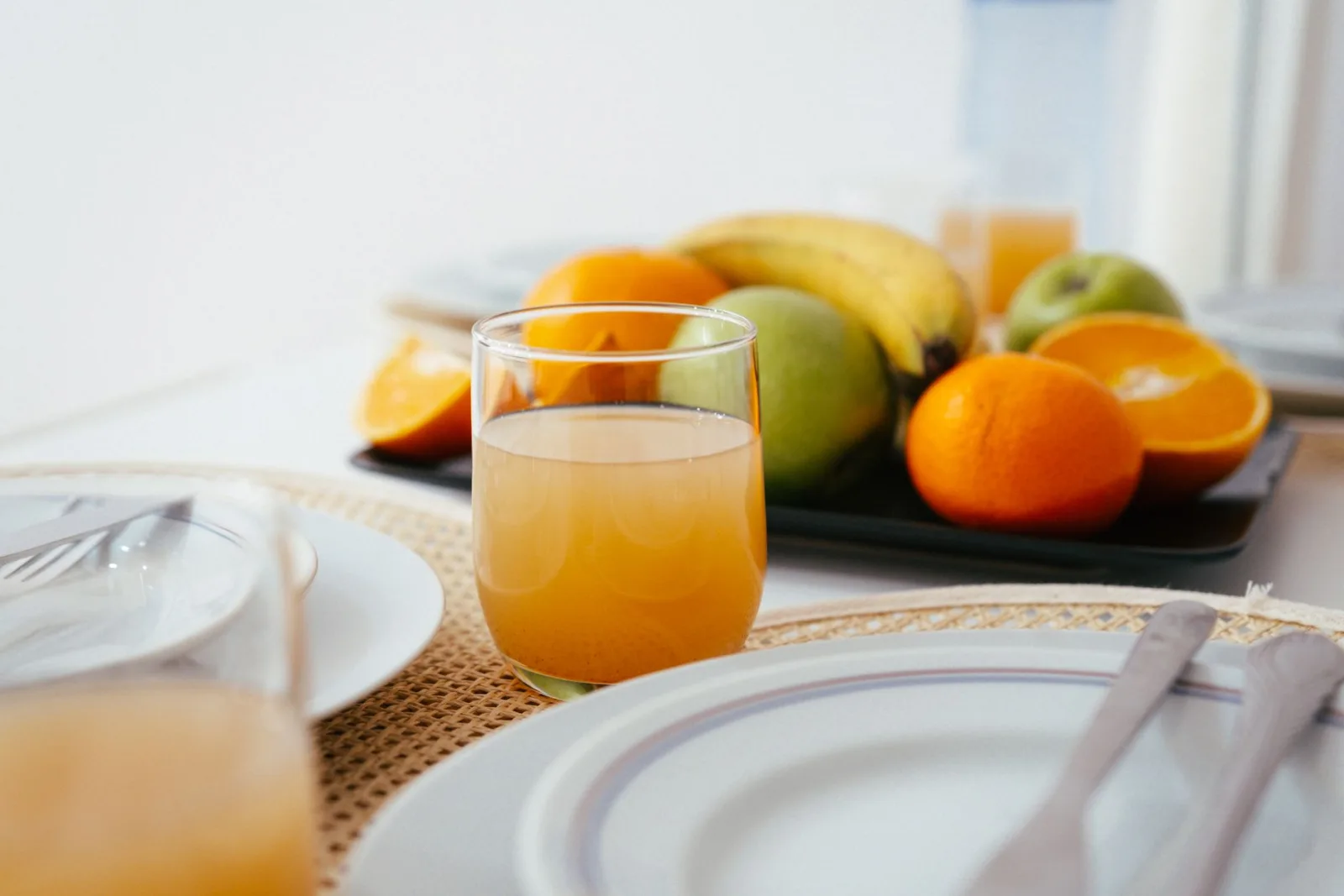
In short:
- A 200 ml glass of orange juice in the morning is about 90 kcal and 17 g of sugars, without the fruit’s fibre.
- A glass takes two to three oranges: you drink their sugar, without the fullness.
- On an empty stomach, the sugar arrives faster and the acidity can bother. Better to drink it during the meal.
- Official guidance: no more than one glass of fruit juice a day. Squeezed or bottled, same story.
Orange juice in the morning has been part of the advertised “ideal” breakfast for decades. The image has stuck, the science has added nuance. A glass of juice is not bad in itself, but it is not the equivalent of a piece of fruit, and when you drink it changes what it does.
What a glass contains
Values vary with orange varieties and brands. For a not-from-concentrate juice, the same orders of magnitude appear everywhere.
| Per | Glass of juice, 200 ml | Whole orange, about 150 g |
|---|---|---|
| Calories | about 90 kcal | about 70 kcal |
| Sugars | 17 to 18 g | about 13 g |
| Fibre | almost none | about 3 g |
| Vitamin C | in the order of 60 to 80 mg | in the order of 70 to 80 mg |
| Oranges used | two to three | one |
The glass supplies roughly the 80 mg of vitamin C of the reference intake shown on European labels. That is its real strength, and it is genuine. The rest of the picture is less flattering: the sugar of two or three oranges, without what came with that sugar in the fruit.
Why juice is not an orange
The difference comes down to one word: fibre. In an orange, the sugar is held in the pulp and membranes. It has to be chewed and digested, and absorption is spread out. In juice, even squeezed to order, most of that fibre stays in the squeezer.
Three practical consequences:
- You drink more fruit than you would eat. A glass goes down in thirty seconds; three oranges are rarely eaten one after another on waking.
- The sugar arrives faster. The glycaemic index of squeezed orange juice is around 50, against about 40 for the whole orange. The mechanism is explained in the article on the low GI breakfast.
- It does not fill you up. A sweet liquid barely counts towards the feeling of fullness. The glass’s 90 kcal are added to the meal without replacing any part of it.
It is for the same reason that a smoothie, which keeps the whole fruit blended, behaves better than juice. The ratios that make a filling smoothie are in the guide on how to make a smoothie.
On an empty stomach, the effect is different
The first glass drunk straight out of bed, on an empty stomach, is the least favourable setting, for two reasons.
Blood sugar. On its own, the sugar in the juice passes quickly into the blood. In the middle of a meal containing protein, fat and fibre, the stomach empties more slowly and the peak flattens out. The same glass therefore does not have the same effect depending on whether it opens breakfast or accompanies it.
Acidity. Orange juice is acidic. For people prone to reflux or heartburn, citrus fruits are among the foods often poorly tolerated, and on an empty stomach the discomfort is more noticeable. For teeth, dentists advise waiting half an hour to an hour before brushing after an acidic drink, as the enamel is temporarily softened.
None of this makes juice dangerous for a healthy person. But the idea that it should be drunk first, “to wake you up”, has no solid basis.
What official guidance says
The World Health Organization recommends limiting free sugars to less than 10 % of energy intake, and ideally to less than 5 %, about 25 g a day for an adult. The sugars naturally present in fruit juice fall into this category, just like added sugar. A 200 ml glass on its own therefore represents two thirds of the ideal daily target.
In France, the guidelines of the national nutrition and health programme place fruit juice among the sugary drinks to limit: no more than one glass a day. A glass at breakfast is already the quota.
Squeezed, not-from-concentrate, from concentrate or nectar
Label wording is regulated by European law, and the terms are not equivalent.
| Wording | What it is | Added sugar |
|---|---|---|
| Home-squeezed | fruit squeezed to order | no |
| Not from concentrate | juice extracted from the fruit, pasteurised, never concentrated | banned |
| From concentrate | concentrated juice reconstituted with water | banned |
| Nectar | juice or purée plus water, at least 50 % fruit for orange | allowed |
Since 2013, adding sugar to any fruit juice has been banned in Europe. A “no added sugar” claim on a not-from-concentrate juice therefore says nothing more than the law does. Only nectar can be sweetened.
Between home-squeezed and not-from-concentrate, the nutritional gap is small: same sugar, same calories, comparable vitamin C. Squeezed juice wins on taste and freshness. The idea that it must be drunk within ten minutes to keep its vitamins is exaggerated: vitamin C breaks down slowly, and a few hours in the fridge in a closed bottle do not lose most of it. The taste, on the other hand, turns quickly.
At brunch, what the glass costs
Squeezed juice is one of the highest-margin extras at brunch, often charged 4 to 6 euros a glass. It takes two to three oranges to fill 200 ml, between 1 and 2 euros of fruit at market prices. In a set menu, it is often the line that pushes the bill up the most for the least pleasure.
At home, a manual squeezer is enough, and juicing oranges, smaller and thin-skinned, yield far more than table oranges. For a group, the same juice also serves as the base for a mimosa cocktail, in equal parts with a dry crémant.
How to drink it better
- A small glass of 125 to 150 ml rather than a large 250 ml one.
- During the meal, with eggs, dairy or nuts, rather than first thing on an empty stomach.
- Not as hydration. The first glass of the morning is water. Coffee comes next, and juice does not need to replace it.
- The whole orange, every other time. It provides as much vitamin C for less sugar, and it fills you up.
- No juice as the liquid in a smoothie. It doubles the sugars without adding anything to the texture, as the dairy-free smoothie explains.
Orange juice is neither a poison nor a health food. It is a sweet drink rich in vitamin C, which has its place on the breakfast table provided it is treated as such.
Frequently asked questions
Is it good to drink orange juice in the morning?
A small glass during breakfast is no problem, and it provides most of the day’s vitamin C. It is not, however, the equivalent of a piece of fruit: a 200 ml glass contains about 17 g of sugars without the fibre that slows their absorption. Official French guidance advises no more than one glass of fruit juice a day.
Should orange juice be drunk on an empty stomach?
It is not the best moment. Drunk alone on an empty stomach, the sugar in the juice reaches the bloodstream faster than in the middle of a meal containing protein, fat and fibre. Its acidity can also bother people prone to reflux. Drinking it during or at the end of breakfast, rather than first, softens both effects.
How much sugar is in a glass of orange juice?
About 8.5 to 9 g of sugars per 100 ml of not-from-concentrate juice, so 17 to 18 g for a 200 ml glass, the equivalent of three to four sugar cubes. This sugar comes from the fruit, none is added: adding sugar to fruit juice has been banned in Europe since 2013. It still counts as free sugar in the World Health Organization’s definition, like the sugar in a soft drink.
Is freshly squeezed orange juice better than bottled juice?
Nutritionally, the difference is small: both contain the same sugar, the same calories and roughly the same vitamin C. Home-squeezed juice keeps more flavour and a little more pulp. The real gap is with juice from concentrate, reconstituted with water, and above all with nectar, which may contain added sugar.
Does freshly squeezed orange juice have to be drunk straight away to keep its vitamin C?
No, the idea that it loses its vitamins within minutes is exaggerated. Vitamin C breaks down with air, light and heat, but slowly: squeezed juice kept for a few hours in the fridge, in a closed bottle, retains most of it. The flavour deteriorates faster than the vitamin C content.