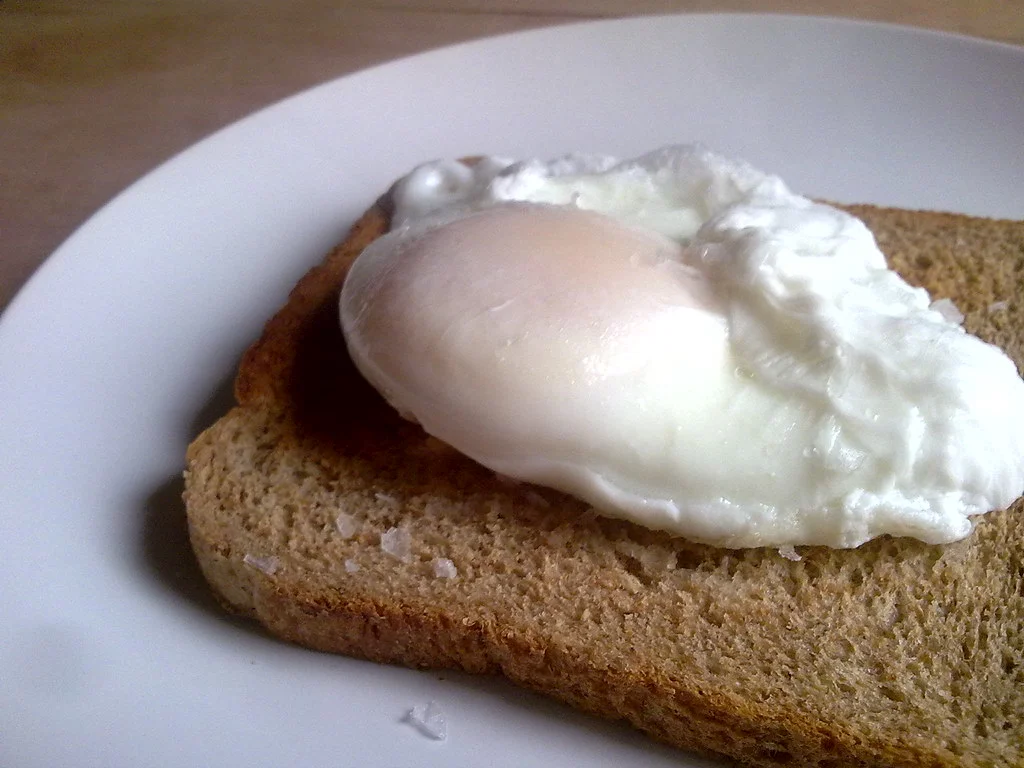
 Photo par Lablascovegmenu via Flickr (CC BY 2.0)
In short:
- The reference time is 3 minutes for a set white and a fully runny yolk, 3 minutes 30 for a creamy yolk.
- Water must be simmering, between 80 and 90 °C, never at a rolling boil: white sets from 62 °C.
- Egg freshness matters more than technique: past nine days, the white liquefies and breaks into strings.
- A poached egg can be made up to 24 hours ahead, chilled in iced water, then reheated for 45 to 60 seconds at 60 °C.
Cooking time, by the result you want
Poached eggs have a reputation for being difficult. In reality the only truly sensitive variable is time, and it is short.
| Time | Result | Use |
|---|---|---|
| 2 min 30 | white barely set, fragile | too tight for service |
| 3 min | white set, fully runny yolk | the brunch reference |
| 3 min 30 | creamy yolk, still soft | eggs benedict |
| 4 min | nearly set yolk | for those who dislike runny |
| 5 min and up | cooked yolk | no longer a poached egg |
The clock starts when the egg hits the water, not when the water returns to a simmer. That is a frequent error, and it easily adds thirty seconds.
Water temperature, the real condition
This is where most failures happen, before timing even comes into play.
Egg white starts to coagulate at 62 °C and yolk at 65 °C. Water at 100 °C therefore adds nothing to the cooking: it agitates the white violently, disperses it and tears it before it has time to set.
The target is simmering water, between 80 and 90 °C: small bubbles rise from the bottom, the surface barely moves. If the water is rolling, drop the heat and wait thirty seconds.
Vinegar, useful but secondary
A tablespoon of white vinegar per litre speeds up surface coagulation of the white. The effect is real but modest: it will not rescue a three-week-old egg, and beyond two tablespoons the taste becomes noticeable.
Egg freshness, which matters more than anything else
This is the decisive factor, and the one you can do nothing about once you are at the pan.
A fresh egg has a dense thick white surrounding the yolk, plus an outer liquid white. Over time the thick white degrades and liquefies. It is what holds the egg together in water: once gone, the white disperses instantly into strings, whatever the technique.
The practical benchmark: less than nine days from laying, with the date printed on the shell or the box. The glass of water test gives the same information: an egg that lies flat is fresh, an egg that stands up or floats is not suitable for poaching.
The method, in five steps
- Crack the egg into a ramekin first, never straight over the pan.
- Strain off the liquid white through a small sieve, keeping the thick white. This often-skipped step removes most of the stringiness.
- Create a whirlpool in the simmering water with a spoon, then slide the egg into the centre.
- Count 3 minutes without touching anything and without raising the heat.
- Drain on kitchen paper for a few seconds before serving.
The whirlpool helps gather the white around the yolk, but it is not essential: with a genuinely fresh egg and calm water, the result is already clean.
Serving six poached eggs at once
This is the real brunch problem, and it has a clean solution. A poached egg does not need to be cooked to order.
- The day before or that morning: poach the eggs and drop them straight into iced water, which stops the cooking dead.
- Storage: up to 24 hours in the fridge, in a container of cold water.
- At service: return them to water at 60 °C for 45 to 60 seconds, drain, serve.
That is what lets you treat eggs like the rest of the table rather than as a last-minute constraint. The overall scheduling logic is described in the article on what brunch is, which sets out what can be made ahead and what cannot.
The rest of the table follows the same logic: pancakes hold in a warm oven for about twenty minutes, and coffee is brewed in two rounds rather than waiting on a hot plate.
Frequently asked questions
How long does a poached egg take to cook?
Three minutes in water simmering between 80 and 90 °C gives a set white and a fully runny yolk, which is what you want at brunch. Allow 3 minutes 30 for a creamy but still soft yolk, and 4 minutes for a nearly set yolk. The clock starts the moment the egg hits the water, not when the water returns to a simmer.
What temperature should water be for a poached egg?
Between 80 and 90 °C, meaning water that releases small bubbles without boiling. Egg white starts to set at 62 °C and yolk at 65 °C, so there is no need for water at 100 °C, which tears the white apart.
Why does my egg white break into strings?
Because the egg is not fresh enough, or the water is boiling too hard. Over time the thick white surrounding the yolk liquefies and disperses the moment it touches water. An egg less than nine days old and simmering water solve the problem in almost every case.
Can you poach eggs in advance?
Yes. Poached eggs go straight into iced water out of the pan, keep for up to 24 hours in the fridge, and reheat in 45 to 60 seconds in water at 60 °C at serving time. It is the only way to serve six poached eggs at once.
Should you add vinegar to the water?
A tablespoon per litre helps the white coagulate faster at the surface, but the effect stays secondary next to egg freshness and water temperature. Beyond two tablespoons per litre the taste becomes noticeable.