In short:
- Breakfast before a session and breakfast after one answer opposite needs.
- Allow 3 hours for a full meal, 1 hour for a snack, before training.
- After training, aim for 20 to 25 g of protein; beyond that the benefit stops rising.
- Fibre before a run is the most common mistake: wholegrain oats and seeds digest badly in motion.
Most articles about the pre-workout breakfast list foods reputed to be good without saying when they are useful. Yet breakfast taken before a session and breakfast taken after one have neither the same purpose, nor the same composition, nor the same digestive constraints. Everything follows from that distinction.
Before a session: emptying the stomach in time
Before training, the aim is simple: have fuel available and an empty stomach. Those two requirements conflict, and timing is what reconciles them.
While the stomach holds a meal, part of the blood flow is taken up by digestion instead of serving the muscles. That is the direct cause of the heavy feeling and, for many people, of the stitch.
Gastric emptying depends mainly on three things: the amount of fat, the amount of fibre, and the total volume. Simple carbohydrate leaves quickly, fat very slowly.
| Time before the session | What suits | Carbohydrate target |
|---|---|---|
| 3 h | Full meal: oats, banana, yoghurt, honey | 1 to 1.5 g per kg |
| 1 h 30 | Snack: white bread and honey, or fruit purée and crispbread | 0.5 g per kg |
| 30 min | Liquid only: a carbohydrate drink, or a very ripe banana | 0.25 g per kg |
For a person of 70 kg, a session in three hours therefore calls for roughly 70 to 100 g of carbohydrate, which is 80 g of oats with a banana and a yoghurt.
The fibre mistake
This is the most common contradiction, and it comes from a good intention.
A healthy breakfast favours wholegrains, seeds and whole fruit, because fibre slows sugar absorption and extends satiety. That is exactly what you want from a low-GI breakfast on an ordinary day.
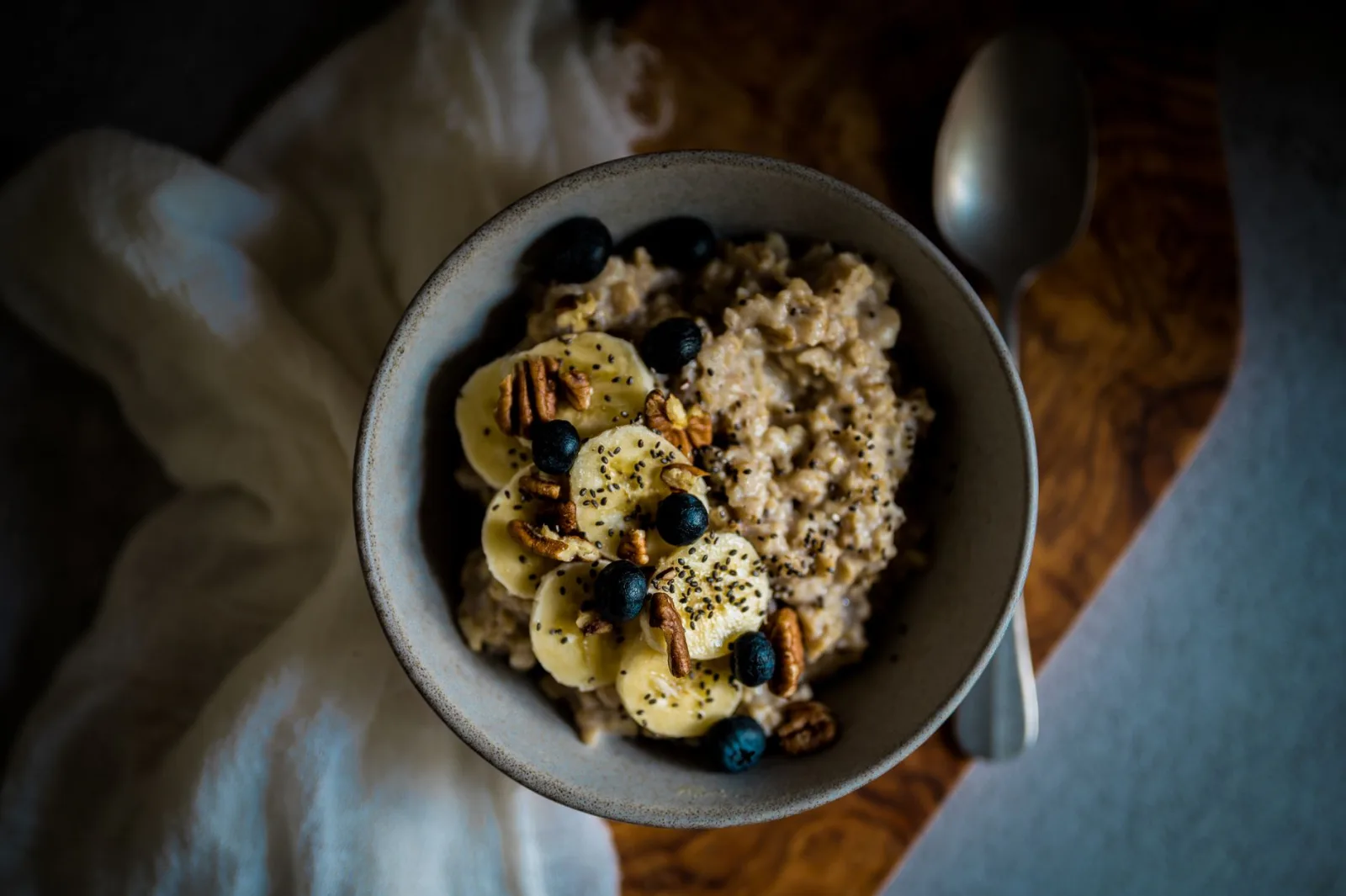
Before a session, that slowing becomes a fault. Fibre increases transit time and intestinal volume, which in motion translates into the bloating and gut trouble familiar to runners. Chia seeds, which absorb up to ten times their weight in water, are a good example of what is better kept for rest days or for the meal after training.
The practical rule: on the morning of a session, white bread beats wholemeal. It is the only time that is true.
After a session: rebuilding
After training, the two aims are to restock the glycogen you used and to supply the amino acids needed for muscle repair. The digestive constraints disappear.
Protein. Twenty to twenty-five grams in a meal is enough to maximally stimulate muscle protein synthesis in an adult. Beyond 30 g the surplus is used in other ways but adds nothing on that front.
| Source | Amount for 20 to 25 g of protein |
|---|---|
| Eggs | 3 whole eggs |
| Fromage blanc | 200 g |
| Greek yoghurt | 200 g |
| Smoked salmon | 90 g |
| Oats | 200 g, but with 130 g of carbohydrate |
Carbohydrate. It does not compete with protein, it accompanies it. After a long session, allow 1 g of carbohydrate per kilo of body weight within two hours.
The so-called anabolic window of thirty minutes, long presented as imperative, is in fact far wider: several hours. Rushing to a snack on the way out of the gym changes nothing decisive if the next meal is sound.
Coffee, the one genuinely documented aid
The effect of caffeine on performance is among the best established in sports nutrition, and it covers both endurance and perceived effort.
The effective dose sits at around 3 mg per kilo of body weight, taken 45 to 60 minutes before exercise, which is the time to peak blood concentration. For 70 kg that is 210 mg, the equivalent of two short espressos or a large mug of filter coffee.
Going up to 6 mg per kilo brings no further benefit and brings out the side effects: tremor, raised heart rate and digestive discomfort. The exact volumes by brewing method are set out in coffee for brunch, where the dosing question arises in another context.
One practical point: coffee without milk leaves the stomach faster. Milk adds protein and fat that slow emptying, which is irrelevant three hours ahead but matters forty minutes ahead.
Training fasted
It makes sense in one specific case and not in the others.
What works: a long endurance session at low intensity, typically a steady aerobic run. With glycogen stores low, the body draws more heavily on fat.
What does not work: any intense session, intervals, strength work, or effort beyond an hour and a half. Liver glycogen is at its lowest on waking after the night, and intensity drops measurably. The session feels harder for less power produced.
Fasted, hydration becomes the critical point: a night’s sleep represents a fluid loss of 300 to 500 ml, which a glass of water on waking only partly makes up.
Three concrete sets
Session in three hours, endurance. 80 g of oats, 250 ml of milk or plant drink, a banana, a spoonful of honey. Around 110 g of carbohydrate, digestion finished in time.
Session in one hour, gym. Two slices of white bread with honey, a large glass of water. Around 45 g of carbohydrate, no fat, no fibre.
After a morning session. Three scrambled eggs, two slices of bread, a piece of fruit. 22 g of protein and 55 g of carbohydrate, the format that is easiest to sustain day to day. A poached egg does the same job if scrambled gets dull.