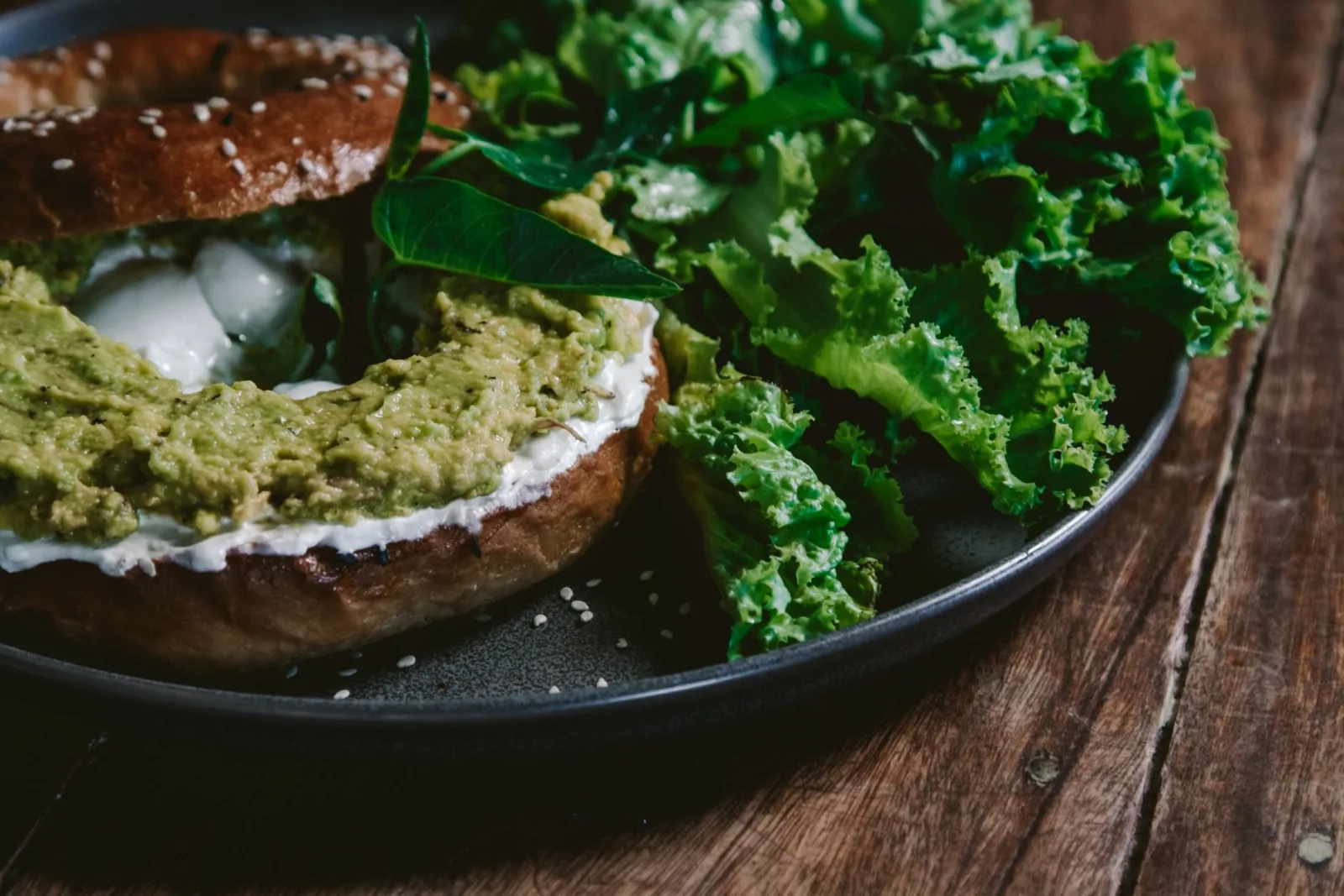
In short:
- Cream cheese goes on both faces, and that is what keeps the bagel from going soggy.
- Allow 60 to 80 g of smoked salmon per bagel, three or four slices.
- A bagel is always toasted on the cut face: cold, its dense crumb is rubbery.
- Allow 4 euros at home against 13 to 16 euros in a brunch café.
The salmon and avocado bagel is the brunch dish that forgives improvisation least, and yet it requires no cooking. Everything comes down to the order of the layers and to moisture: badly built, it goes soggy before you finish it and slides apart at the first bite.
What makes a bagel different
A bagel is not a round roll. It is boiled in water before being baked, for a few dozen seconds. That step gelatinises the starch at the surface and gives the bagel its two defining features: a thin, glossy crust and a very dense, almost compact crumb.
Two practical consequences follow.
First, a cold bagel is rubbery. Its dense crumb lacks air pockets, and under the tooth it resists rather than yields. That is why it is always toasted, unlike a brioche, which is perfectly good as it is.
Second, that dense crumb absorbs slowly but deeply. Once it has taken up moisture it never dries out again: the bagel stays soft to the end. Hence the importance of the barrier described below.
The weights, per bagel
| Element | Amount | Note |
|---|---|---|
| Bagel | 1, 85 to 100 g | plain or sesame, poppy seeds stain |
| Cream cheese | 40 g | 25 g on the base, 15 g on the lid |
| Avocado | half, about 70 g | ripe but firm under the thumb |
| Smoked salmon | 60 to 80 g | 3 to 4 slices |
| Red onion | 10 g | sliced very thin |
| Capers | 1 teaspoon | drained and patted dry |
The salmon weight is what varies most from one place to another. A bagel charged at 14 euros rarely contains more than 50 g, which explains the common feeling of paying mostly for the bread.
The build order, which decides everything
It is the only real skill in the dish, and it comes down to one idea: the bread must never touch anything wet.
One. Toast both halves, cut face towards the element, for two to three minutes. The surface should be golden and dry to the touch.
Two. Spread the cream cheese on both faces, straight away, while the bread is still hot. That double layer is the barrier. It is the step most often skipped, and it is what makes the difference ten minutes later.
Three. The avocado on the base only, mashed with a fork rather than sliced. Mashed, it grips the cream cheese and stays put. Sliced, it becomes a slip plane and the filling comes out of the bagel at the first bite.
Four. The salmon on top, in loose folds rather than flat. The folds trap the condiments and give height without adding quantity.
Five. Red onion, capers and dill right at the top, then the lid. Never put condiments underneath: they puncture the cream cheese layer.
Choosing the cream cheese
They are not all equal, and the criterion is their water content.
A full-fat cream cheese contains about 60 % water and stays firm at room temperature: that is the right choice, it holds the barrier. Light versions go up to 75 % water, spread into too thin a layer and turn liquid against the hot bread. The result is the exact opposite of what you wanted.
Take the cream cheese out of the fridge ten minutes ahead. Cold, it tears the bagel crumb instead of spreading over it.
The avocado, and the oxidation question
Lemon slows browning but does not prevent it: it lowers the pH and holds back the enzyme responsible without switching it off. Mashed avocado with lemon holds for about an hour before turning, against twenty minutes with nothing.
The only method that really works is to mash it at the last moment, which takes thirty seconds. It is the same logic as for avocado toast, where the freshness of the mash is half the result.
On choosing the fruit: it should yield under firm thumb pressure without being soft. An over-ripe avocado gives a grey purée; a hard one will not mash and has no flavour at all.
Smoked salmon, and how it differs from gravlax
Cold-smoked salmon is salted and then smoked at 20 to 30 °C: it stays raw, translucent, and slices thinly. That is the one for a bagel.
Gravlax is not smoked at all. It is cured in salt, sugar and dill, which gives it a firmer texture and a milder flavour. It works on a bagel, but its fat is less present and it sits less well against the cream cheese.
Hot-smoked salmon, flaked and opaque, does not suit: it crumbles and forms no layer.
In every case, take the salmon out ten minutes ahead. Straight from the fridge its fat is set solid and it loses much of its flavour, exactly like cheese served too cold.
What it costs, and why the gap is so wide
| Item | Home cost |
|---|---|
| Bagel | 0.60 to 0.90 € each |
| Smoked salmon, 70 g | 2.50 to 3.00 € |
| Cream cheese, 40 g | 0.35 € |
| Avocado, half | 0.60 € |
| Total | about 4 € |
Charged at 13 to 16 euros in a café, it is one of the brunch dishes where the gap is hardest to justify: it requires no cooking, no technique and no watching. It is one of the things that separate what is worth ordering from what is better made at home, a distinction set out in what a brunch actually is.
For several people
A bagel is built on the plate, never in advance. For four guests, the sensible approach is to toast the bagels two at a time while the components wait in separate dishes, and let everyone build their own. That is also the logic of a breakfast tray: components on one side, assembly at the last moment.