In short:
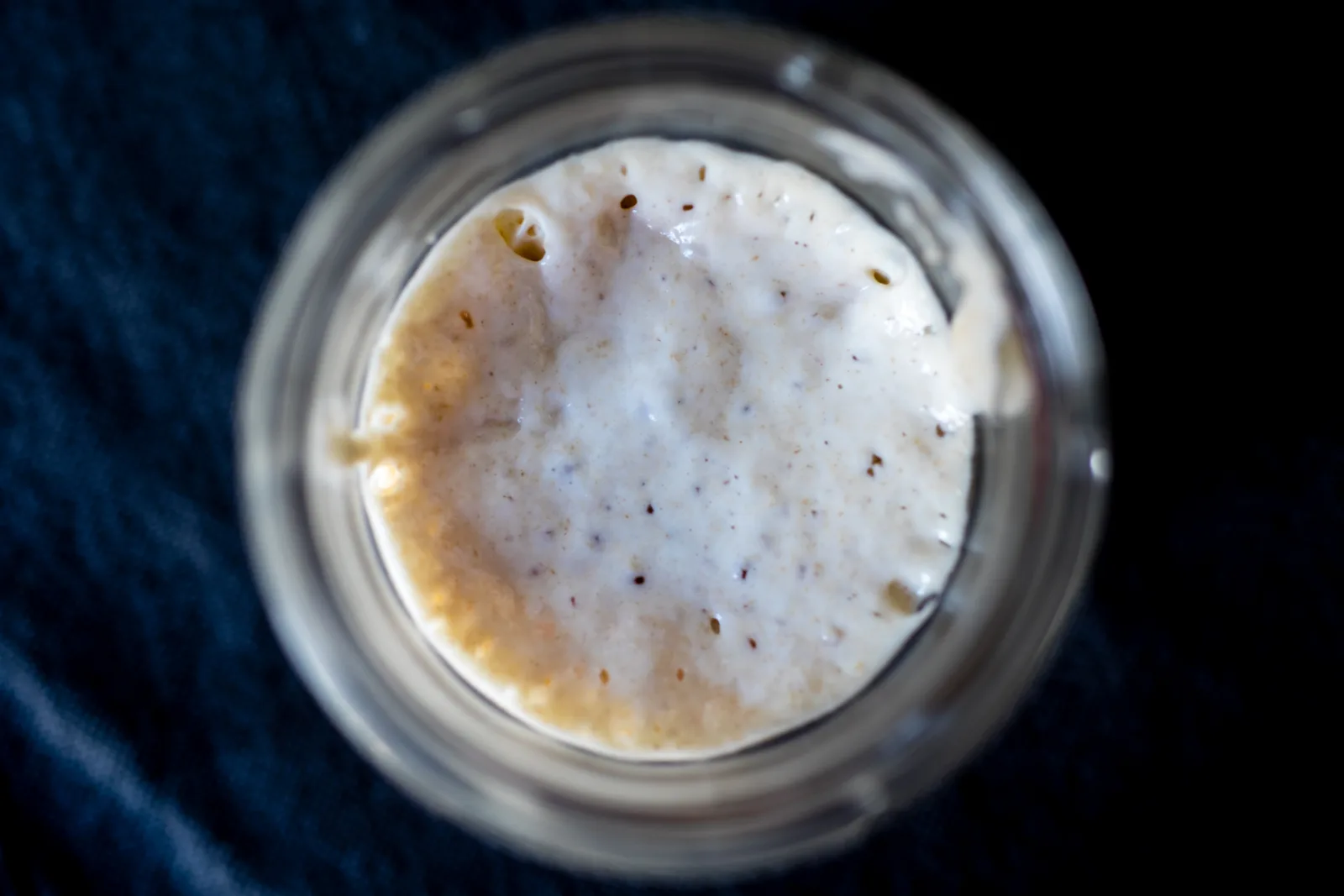
- A sourdough starter for brioche must be young and mild: two or three feedings within 24 hours, used at its peak.
- Dose: 20 to 30 % of the flour weight in liquid starter, so 150 g for 500 g.
- The starter brings flour and water: take 75 g of flour and 75 g of liquid out of the original recipe.
- Allow around twenty hours in total, including a night in the cold. A pinch of yeast on top secures the rise.
A sourdough starter for brioche is not prepared like a starter for a country loaf. Brioche is one of the hardest doughs to raise: 50 % butter, 12 % sugar and a dough moistened almost entirely with eggs. All of this slows down the wild yeasts in the starter. And the sourness that gives a sourdough loaf its charm becomes a fault in a crumb that is expected to be soft and buttery.
So the work happens upstream, on the starter itself, far more than on the dough. The dough follows the same logic as the old-fashioned brioche recipe: gluten network first, butter second, a night in the cold.
Liquid starter or stiff starter
A starter is a culture of wild yeasts and lactic bacteria kept alive by feedings, that is, regular additions of flour and water. Two forms exist side by side, distinguished by their hydration.
| Liquid starter | Stiff starter | |
|---|---|---|
| Hydration | 100 %, as much water as flour | around 50 % |
| Texture | pourable, like a thick batter | supple dough that can be kneaded |
| Acidity | mild, lactic | sharper if kept cool |
| Strength | decent | higher |
| Ease | the simplest to manage | needs more attention |
For a first brioche, a liquid starter is the right choice. It mixes easily into an already very rich dough, and it mainly produces lactic acid, with yoghurt notes. A stiff starter kept cool develops more acetic acid, which is sharper. Yet it is a stiff starter that makes the great Italian brioches such as panettone, but fed very often and kept warm precisely so it stays mild.
The feedings that make the starter mild
A starter taken out of the fridge after a week is too acidic and too slow for brioche. It has to be woken up and “washed” of its acidity through close feedings.
- First feeding, the morning before: 1 part starter to 2 of flour and 2 of water, for example 25 g of starter, 50 g of T65 flour and 50 g of lukewarm water.
- Leave at 25 to 28 °C until it doubles, in 4 to 6 hours.
- Second feeding, in the same proportions, starting from 25 g of this starter. The rest is discarded.
- A third feeding if the starter still smelled of vinegar at the second. Each round dilutes the accumulated acidity and strengthens the yeasts.
- Use at the peak, when the starter has doubled or tripled, its surface is domed and covered in bubbles, and it smells of yoghurt or fruit, not vinegar or acetone.
The peak lasts one to two hours. After that, the starter collapses and turns acidic, and it is precisely a collapsed starter that gives a sour brioche.
Temperature matters as much as rhythm. Below 22 °C, the starter sours more than it rises. An oven switched off with the light on, or the top of a fridge, often sits around 26 °C.
How much goes into the dough
Starter is measured as a percentage of the total flour weight. For a brioche, the useful range is 20 to 30 % of active liquid starter. Below that, the rise drags on for too long in such a rich dough. Above it, the sourness starts to show.
The point not to forget: a liquid starter is half flour, half water. 150 g of starter brings 75 g of flour and 75 g of water, which must come out of the recipe to keep the same dough.
Converting a yeast recipe
Based on a brioche with 500 g of flour, 6 eggs and 250 g of butter:
| Ingredient | Yeast version | Sourdough version |
|---|---|---|
| Strong white flour or T45 | 500 g | 425 g |
| Active liquid starter | 0 | 150 g |
| Fresh yeast | 10 to 12 g | 0, or 2 to 3 g as insurance |
| Whole eggs | 6, about 300 g | 5, about 250 g |
| Milk | 2 to 3 tablespoons | 0 |
| Unsalted butter | 250 g | 250 g |
| Sugar | 60 g | 60 to 70 g |
| Salt | 10 g | 10 g |
The egg and milk removed roughly offset the 75 g of water in the starter. The sugar can go up slightly to balance the small residual acidity, without exceeding 15 % of the flour weight: beyond that, it slows the starter even more.
Yeast as insurance is not cheating. Many bakers combine starter with a small dose of yeast in rich doughs. 2 to 3 g of fresh yeast shorten the final proof by several hours and keep most of the starter’s flavour. For a first attempt, it is the option to favour.
It should not be confused with a yeasted pre-ferment, made of flour, water and baker’s yeast, with no natural starter. It adds some fermentation flavour, but it does not make a sourdough brioche.
The two-day timetable
The starter slows everything down. Allow around twenty hours between the last feeding and taking the brioche out of the oven, which fits over a weekend. Example for a brioche served at Sunday brunch, whose usual hours revolve around midday:
| Time | Step | Duration |
|---|---|---|
| Saturday 8 am | First feeding | 4 to 6 h |
| Saturday 1 pm | Second feeding | 4 to 6 h |
| Saturday 6 pm | Kneading, butter added last | 30 min |
| Saturday 6:30 pm | Bulk rise at room temperature | 3 to 4 h |
| Saturday 10 pm | Fold, then overnight in the fridge | 9 to 10 h |
| Sunday 7 am | Shaping while cold | 20 min |
| Sunday 7:30 am | Final proof between 26 and 28 °C | 4 to 5 h |
| Sunday 12 pm | Bake at 180 °C | 25 to 30 min |
The final proof is the longest and least predictable step. The dough should have clearly swollen, at least doubled, and spring back slowly when pressed with a finger. Do not go above 28 °C to speed it up: beyond that, the butter melts and seeps out of the dough.
With 2 to 3 g of yeast added, the final proof drops to around 2.5 to 3 hours, and the brioche can come out of the oven before 11 am.
The mistakes that ruin a sourdough brioche
- Using the starter straight from the fridge. It is acidic and half asleep: the brioche barely rises and smells sour.
- Waiting for the starter to collapse. The peak is the only right moment, and it does not last.
- Forgetting to remove the starter’s flour and water. The dough becomes sticky and impossible to shape.
- Proofing too warm. Above 28 °C, the butter separates from the dough.
- Baking too early. An under-proofed sourdough brioche is dense and tight. The proof is judged by volume, not by the clock.
What the starter changes on the plate
A sourdough brioche does not taste like a sourdough loaf. Done well, the acidity is barely noticeable, in the background. It brings a slightly more melting crumb, a longer flavour and better keeping: the brioche stays soft a day longer than a yeasted one, as the acidity slows staling.
It is not any lighter for all that: the butter and eggs are the same. Once stale, it makes an excellent traditional French toast, its slight acidity balancing the sweetness of the custard. And in thick slices on a breakfast tray, it easily replaces pastries bought the day before.
On cost, 425 g of flour, 250 g of butter and 5 eggs come to about 5 euros for a brioche of over a kilo, while sourdough brioche from artisan bakeries is among the most expensive items in the window. The only real cost is time, and most of it is spent waiting.
Frequently asked questions
Which starter should be used for brioche?
A young, mild starter, fed two or three times in the preceding 24 hours and used at its peak. A liquid starter, at 100 % hydration, is the easiest to manage and gives a discreet acidity. A stiff starter, at around 50 % hydration, has more strength, but it has to be kept warm so it does not turn sharp. A starter taken straight from the fridge without feeding is unsuitable: too acidic and too slow for a dough loaded with butter.
How much starter goes into a brioche?
Between 20 and 30 % of the total flour weight in active liquid starter, so 100 to 150 g for 500 g of flour. That starter is itself half flour, half water, so those amounts come out of the recipe. With 150 g of starter, the dough takes 425 g of flour instead of 500 and about 75 g less liquid, which means dropping one egg and the milk.
Why does my sourdough brioche taste sour?
Almost always because the starter was used too old, past its peak, or without preliminary feedings. A starter that smells of vinegar or acetone has built up acidity that passes into the crumb. Two or three close feedings at 1 part starter to 2 of flour and 2 of water, kept between 25 and 28 °C, bring back a yoghurt smell and a barely noticeable acidity.
How long does a sourdough brioche take?
Allow around twenty hours from the last feeding to coming out of the oven, including a night in the fridge. The starter takes 4 to 6 hours to peak, the dough rises for 3 to 4 hours at room temperature before chilling, then 4 to 6 hours after shaping. Butter, sugar and eggs slow the starter down considerably, which explains timings two to three times longer than with yeast.
Can you use both starter and yeast in a brioche?
Yes, and it is common practice in bakeries. 2 to 3 g of fresh yeast per 500 g of flour, added alongside the starter, secures the final proof and shortens the schedule by several hours while keeping most of the starter’s flavour. It is the right option for a first sourdough brioche or for a starter that is still young.