In short:
- The everyday Spanish breakfast is a coffee and a tostada, taken at the bar in ten minutes.
- Churros are not daily: they are a weekend or festival breakfast.
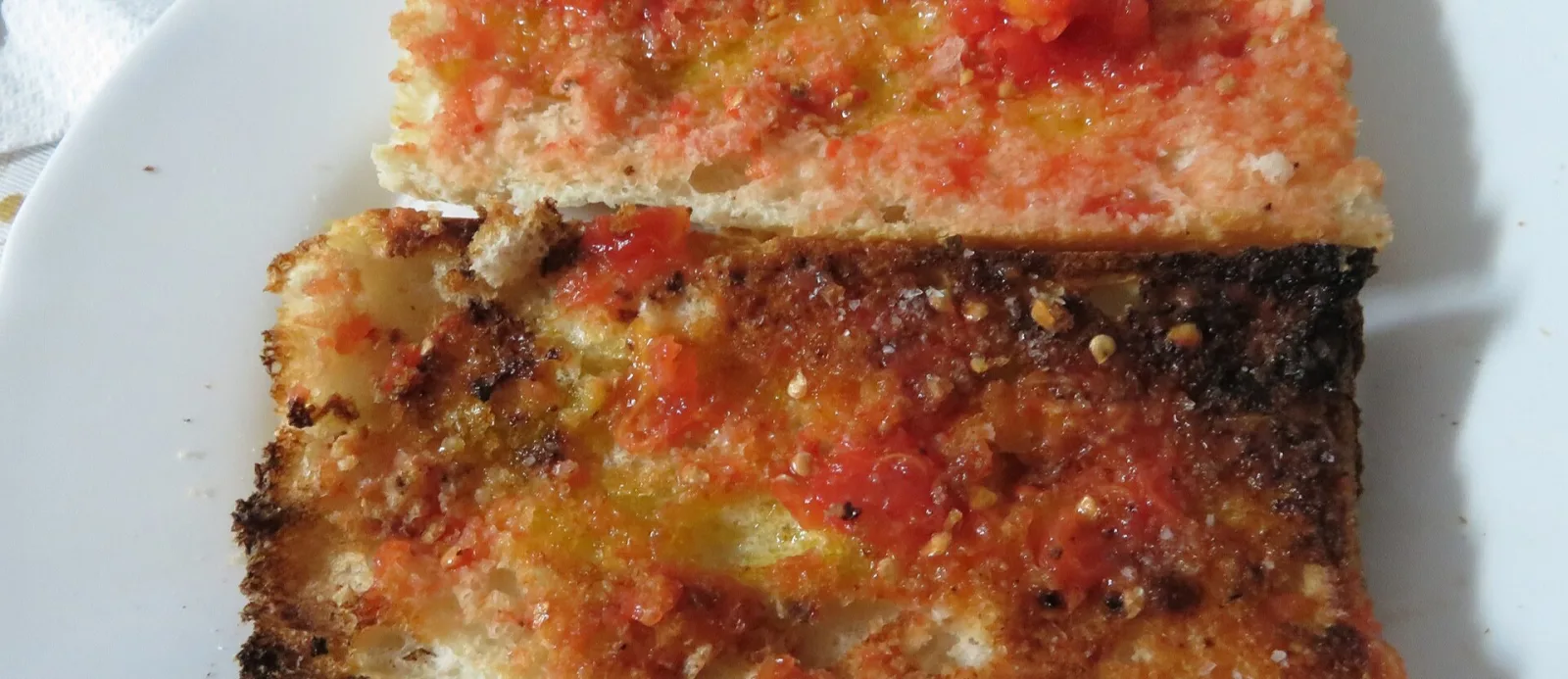
- The tomato on a tostada is grated, never sliced.
- There are two breakfasts: the desayuno at eight and the almuerzo at around eleven.
The Spanish breakfast is widely misrepresented outside Spain, where it is often reduced to churros. The daily reality is far simpler, far quicker, and it almost always happens away from home.
What it really is: light, and at the counter
The ordinary Spanish breakfast comes down to two things: a coffee and something on bread. There are no eggs, no charcuterie in any quantity, and no sweet spread.
It is taken mostly at a bar, not at home. The Spanish neighbourhood bar opens early, serves at the counter, and sees the same faces every morning. The meal lasts ten minutes, standing or on a stool, often with the paper alongside.
That is a structural difference from brunch, which is a long, seated meal, as the definition of brunch and its hours sets out. The Spanish desayuno is its exact opposite: short, functional and cheap.
Tostada con tomate, the central dish
It is the most widespread breakfast in Andalusia, in Madrid and across most of the country.
The bread. A thick slice of country bread, or half a mollete around Antequera, toasted until golden but not dry.
The tomato. This is the step that counts. You halve a ripe tomato and rub it against a coarse grater, cut side down. The skin stays in your hand, the pulp falls through grated, loose and without pieces. That pulp soaks into the crumb rather than sliding over it, which sliced tomato never does.
The olive oil. Extra virgin, generously, poured on after the tomato. In Spain it sits on the counter in a cruet and everyone helps themselves.
The salt. Last, not before: salted too early, the tomato weeps and the bread goes soggy.
Common variations add serrano ham on top, or replace the tomato with manteca colorá, a paprika lard typical of Seville.
The real regional variations
| Region | Morning speciality | What it is |
|---|---|---|
| Andalusia | Tostada con tomate, pan de aceite | Toasted bread, grated tomato, olive oil |
| Basque Country and Navarre | Pincho de tortilla | A wedge of potato omelette, cold or warm |
| Catalonia | Pa amb tomàquet | The same logic, tomato rubbed rather than grated |
| Madrid | Porras con chocolate | The thick version of churros, at weekends |
| Galicia | Pan de maíz and charcuterie | Dense corn bread, more rustic |
The northern pincho de tortilla deserves a special mention: a wedge of tortilla de patatas, served at room temperature on a slice of bread, is an extremely common breakfast in Bilbao or Pamplona, and it has nothing to do with the toasted bread of the south.
Churros, put back in their place
Churros con chocolate do exist, but their place is misunderstood.
They are eaten at weekends, on feast days, and traditionally in the early hours at the end of a night out. In the big cities, the historic churrerías serve until dawn.
They are not sweet doughnuts: churro dough contains neither sugar nor egg, only flour, water and salt. The sugar comes from the dusting and above all from the thick chocolate they are dipped in, which is a drink in its own right and far denser than a French hot chocolate.
Porras are their wide, soft version, more common in Madrid; thin, crisp churros dominate elsewhere.
The coffee vocabulary, useful at the counter
Ordering coffee in Spain takes a precise word, without which you rarely get what you expected.
| Order | What arrives |
|---|---|
| Café solo | An espresso, on its own |
| Café cortado | An espresso with a dash of hot milk |
| Café con leche | Half espresso, half hot milk, the usual morning order |
| Café bombón | Espresso and sweetened condensed milk, very sweet |
| Carajillo | Espresso and spirits, not a morning coffee |
Café con leche is the default breakfast order. It comes in a glass or a small cup, rarely in a large bowl.
One detail that often surprises visitors: Spanish bar coffee is usually torrefacto, roasted with a proportion of sugar that caramelises on the bean. That gives a more bitter, heavier coffee, and it is one reason it is almost always drunk with milk. How extraction affects bitterness is set out in coffee for brunch.
The two breakfasts of the morning
This is the point most often missed, and it explains everything else.
The desayuno, at about eight, is very light: the coffee and tostada described above.
The almuerzo, at around eleven, is the real morning meal. A bocadillo, a long bread roll filled with tortilla, ham or squid, a wedge of tortilla, sometimes a short beer. It is taken at the bar, often with colleagues, and it is as much a social break as a meal.
That second slot is what allows Spanish lunch to arrive at half past two or three without anyone suffering. Without the almuerzo the gap would be unbearable.
A morning in two parts brings Spain close to the logic of Anglo-Saxon brunch, with one fundamental difference: both meals stay short and separate, where brunch merges two into a single long, seated one. The simultaneous abundance of a Turkish breakfast is its exact opposite.
Making it at home
It is one of the easiest breakfasts to reproduce, because it needs no technique and three ingredients.
A ripe tomato, country bread, good olive oil. The only real criterion is the quality of the oil: it carries all the flavour, and an ordinary oil gives a flat tostada. Allow about 0.80 euro per person.
On a breakfast tray, a tostada holds badly: it goes soggy within minutes. It is made and served immediately, which is exactly the logic it came from.