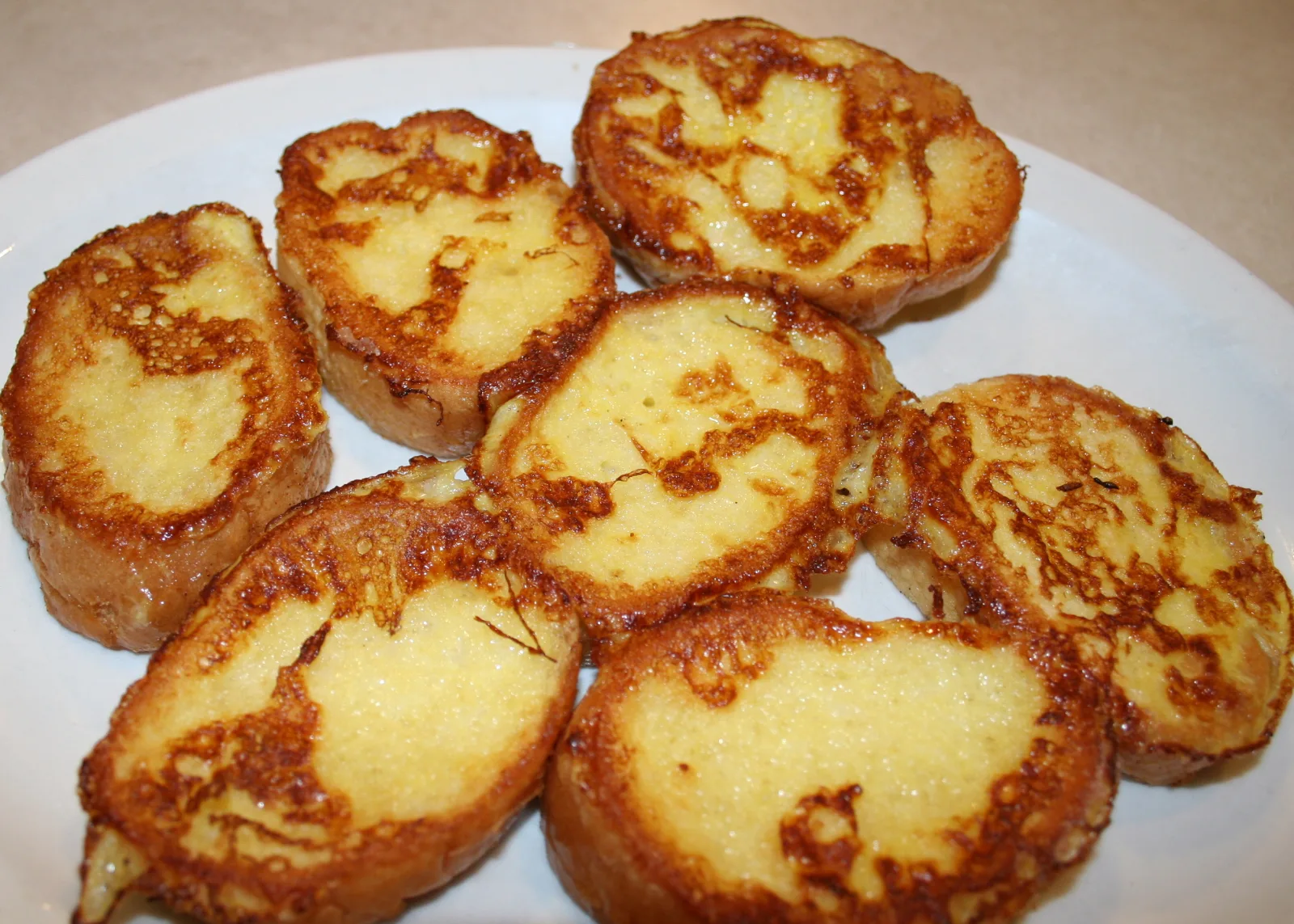
In short:
- The traditional recipe has five ingredients: stale bread, whole milk, eggs, sugar, butter. No cream, no brioche.
- The base ratio: 2 eggs and 250 ml of milk for 4 slices, one egg for every 120 ml of milk.
- Soaking time depends on the bread, from ten seconds for brioche to two minutes for a very dry baguette.
- Cook over medium heat, two to three minutes a side, in foaming butter that must never turn black.
Traditional French toast, the French pain perdu, is not a pastry at all. It is a household recipe, made to rescue dry bread that would otherwise have been thrown away, hence its French name, “lost bread”. All it needs is bread from the day before or the day before that, a little milk, eggs, sugar and butter.
It is also the brunch dish with the most spectacular gap between cost price and menu price. Making it at home is not difficult, as long as two settings are respected: soaking time and heat.
What “old-fashioned” actually means
The expression does not refer to a fixed recipe but to a logic: use stale bread, and nothing richer than what an ordinary kitchen holds.
The idea is very old. The Roman collection attributed to Apicius already describes white bread soaked in milk, fried in oil and covered in honey. At the end of the Middle Ages, Le Ménagier de Paris, around 1393, gives “tostées dorées”: hard white bread, sliced, dipped in beaten egg yolks and browned in a pan.
Almost every European cuisine has its own version, which says a lot about its domestic origin: pain doré in Quebec, torrijas in Spain, Arme Ritter in Germany, French toast in English-speaking countries.
What has been added since belongs to the brunch menu: thick brioche, cream in the custard, toppings of berries and syrup. It is good, but it is no longer the traditional recipe, and it is above all what justifies the price.
The ratios for four slices
| Ingredient | Quantity | Role |
|---|---|---|
| Stale bread, 2 to 3 cm slices | 4 slices, or 8 rounds of baguette | the structure |
| Eggs | 2 | binding, colour |
| Whole milk | 250 ml | soaking, softness |
| Sugar | 30 g, 2 tablespoons | taste, caramelisation |
| Salt | 1 pinch | depth |
| Vanilla, cinnamon or orange blossom | to taste | aroma |
| Butter | 30 g | cooking and nutty flavour |
The ratio that matters is roughly one egg for every 120 ml of milk. With more milk, the custard does not set and the centre stays liquid. With more egg, the French toast tastes like a sweet omelette and turns rubbery.
Whole milk is not a detail. Its fat gives the soft centre. Skimmed milk works, but the result is drier and blander.
Whisk the eggs with the sugar and salt before adding the milk: the sugar dissolves better and the custard is even. Otherwise, strands of poorly beaten egg white end up as white patches on the surface of the bread.
The bread, and the soaking time that goes with it
Stale bread is not a constraint of the recipe, it is its condition. Dry bread absorbs the custard without falling apart, while fresh bread, already full of moisture, breaks up as soon as it is lifted. Two to three days of staling give the best result, as with the eggless French toast version.
Soaking time varies tenfold depending on the bread:
| Bread | Condition | Soaking per side |
|---|---|---|
| Baguette | very dry, brittle | 1 to 2 minutes |
| Country loaf | 2 days stale | 30 seconds to 1 minute |
| Milk bread | stale | 15 to 20 seconds |
| Brioche | stale | 10 to 15 seconds |
The most reliable test is touch: the slice should be soft right to the centre when pressed lightly, yet still able to be lifted in one piece. If it bends, it has soaked too long.
Baguette is the bread most faithful to the spirit of the recipe, since it is the French bread that goes stale fastest. Sliced on the bias, it gives wide rounds that brown evenly. A stale old-fashioned brioche makes richer, meltier French toast, as long as soaking is cut sharply: its buttery crumb drinks the custard in seconds.
Cooking, over medium heat and no higher
This is the step where most French toast fails, because it is cooked like a crêpe, over high heat.
- Foam the butter over medium heat. When the foam subsides and the butter smells nutty, the pan is ready. If it blackens, it is too hot.
- Lay the slices in without crowding. Two slices touching each other steam one another.
- Allow two to three minutes per side. The underside should be deep golden and release from the pan on its own.
- Turn only once, with a wide spatula.
- Sprinkle a little sugar on the cooked side just before turning back, or at the end: it caramelises in thirty seconds and gives the crackly crust of grandmother’s French toast.
Medium heat has a precise reason. Egg sets at around 65 to 70 °C: the heat needs time to reach the centre of the slice while the outside browns. Over high heat, the surface burns and the middle stays raw and runny.
A spoonful of neutral oil added to the butter delays the point at which it burns, useful when cooking several batches.
The mistakes that ruin French toast
- Fresh bread. It falls apart while soaking, and what remains is spongy once cooked.
- Soaking too long. The slice becomes saturated, breaks when lifted, and the centre never cooks.
- Too much sugar in the custard. Beyond 40 g for 250 ml of milk, it burns in the pan before the bread is cooked.
- An overcrowded pan. The temperature drops, the water from the milk stops evaporating, and the French toast boils instead of browning.
- Serving straight onto a cold plate. Steam from underneath softens the crust. One minute on a rack is enough to avoid it.
What French toast costs at home
The calculation is worth making. For four slices: leftover bread that would have been thrown away, 2 eggs at around 60 cents, 250 ml of milk at 30 cents, sugar and butter for around 40 cents. Under 1.50 euros for four, about 35 cents a serving.
On a brunch menu, brioche French toast is commonly priced between 9 and 14 euros. The fruit topping and syrup explain part of the gap, not most of it. It is the same reasoning as for the whole formula, set out in what is brunch: the simplest dishes to produce are often those carrying the highest margin.
It is, however, a full breakfast, not a snack: the whole recipe comes to about 1,100 kcal, cooking butter included, or around 550 kcal for two slices. A bowl of café au lait adds about 70, according to the café au lait calories broken down by type of milk.
Frequently asked questions
What is the traditional French toast recipe?
For four thick slices of stale bread: 2 eggs, 250 ml of whole milk, 30 g of sugar, a pinch of salt, a little vanilla or cinnamon, and 30 g of butter for the pan. Whisk the eggs with the sugar and the milk, soak the bread just long enough for it to absorb without falling apart, then brown it two to three minutes a side in foaming butter over medium heat.
Which bread should be used for old-fashioned French toast?
Bread that is two to three days stale: baguette, country loaf or milk bread. That is the very principle of the recipe, which exists so that dry bread is not wasted. Fresh bread is already full of moisture and falls apart in the custard. Brioche gives a richer result, but it is a modern brunch-menu version, not the original recipe.
How long should French toast soak?
It depends on how dry and dense the bread is. A very dry baguette needs one to two minutes a side, a stale country loaf thirty seconds to one minute, milk bread or brioche only ten to fifteen seconds. The reliable test is touch: the slice should be soft right to the centre, yet still able to be lifted in one piece.
Why is my French toast soggy?
Three possible causes, often combined: bread that is too fresh, soaking that is too long, or heat that is too high, browning the outside before the egg has set in the middle. Over medium heat, the inside has time to cook like a custard and the slice holds. Letting it rest for a minute on a rack before serving also helps the crust stay crisp.
Can French toast be prepared the night before?
The custard, yes: eggs, milk and sugar whisked together keep overnight in the fridge, covered. The soaking and cooking, no. Bread soaked the night before turns to mush, and French toast cooked then reheated loses its crispness. For a group, cook at the last minute and keep the slices warm in a 90 °C oven, on a rack, for no more than fifteen minutes.