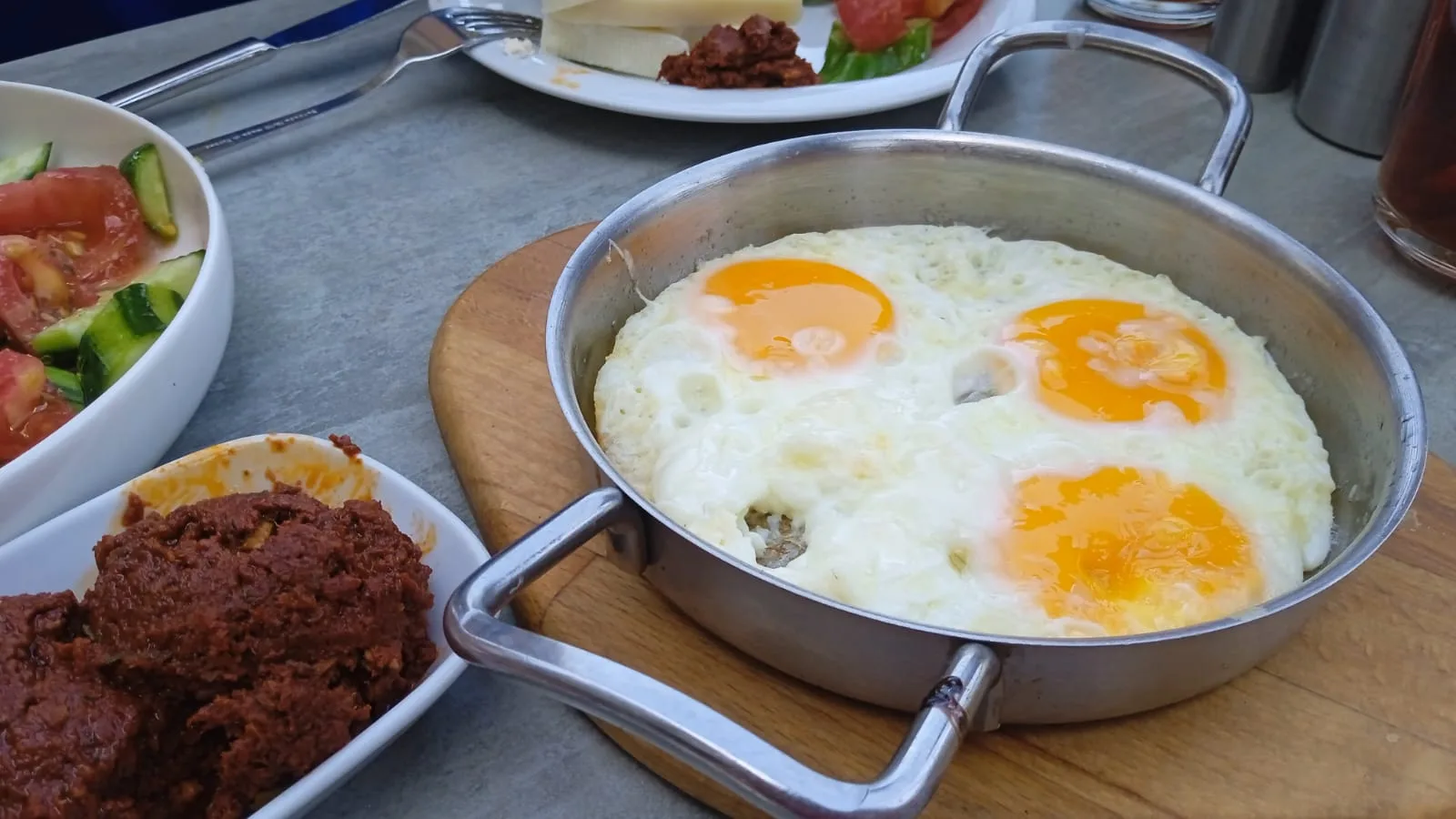
In short:
- Kahvaltı is a genuine morning meal, almost entirely savoury, not a brunch.
- It rests on assembling raw products, not on preparations: that is what makes it easy to recreate.
- The only real cooking is one hot dish, menemen or çılbır.
- The drink is black tea, refilled several times, not coffee.
The Turkish breakfast is the most photographed morning meal and the most poorly reproduced in the kitchen. The reason is simple: it gets taken for a brunch, when its logic is the opposite. It is not about cooking several dishes, it is about cooking one and buying the rest well.
What kahvaltı means
The Turkish word breaks down into kahve altı, literally “before coffee”. It refers to the meal eaten before the first cup of the day, so early, and not a late meal replacing lunch.
That etymology says most of what separates it from brunch:
| Turkish breakfast | Brunch | |
|---|---|---|
| Timing | early morning | between 11 am and 2 pm |
| Meal replaced | none, it is breakfast | lunch |
| Dominant register | savoury | mixed, often sweet |
| Service | small shared plates in the middle | individual plates |
| Cooking work | one hot dish | several preparations |
The definition and timing of brunch in the French sense are covered in what is brunch. The two meals look alike in photographs and have almost nothing in common in preparation.
What is really on the table
A typical table carries between six and twelve small plates, served all at once. None of them is a dish in its own right, and it is their accumulation that makes the meal.
The cheeses. Beyaz peynir, a brined sheep’s cheese close to feta but less salty, and kaşar, a milder pressed yellow cheese. Those are the two essentials.
The olives. Green and black, served separately, often simply dressed with olive oil and oregano. They appear at every morning meal, including in modest households.
The raw vegetables. Tomatoes and cucumbers cut into thick slices, sometimes green pepper. Raw, unseasoned, they are there to lighten the whole.
The sweet side, in limited quantity. Cherry or apricot jam, honey, and above all kaymak, a very rich clotted cream eaten with honey on bread. It is the only outright rich item on the table.
The cured meats. Sucuk, a spiced dried beef sausage, pan-fried, and pastırma, air-dried beef in thin slices.
The bread. Fresh white bread, and above all the simit, a sesame-crusted bread ring sold in the street and widely considered the real star of the table.
The two hot dishes
This is the only place where actual cooking happens, and one of the two is enough.
Menemen
Eggs scrambled slowly into a base of tomatoes, green peppers and softened onions, often lifted with mild chilli. It is cooked and served in a small metal pan set straight in the middle of the table, and eaten with bread.
The technical point is the same as for any scrambled eggs: low heat and stopping the cooking early. The eggs keep cooking in the scorching pan after it leaves the heat. The detailed method applies here too, and is in creamy scrambled eggs.
Çılbır
Poached eggs set on a bed of garlic yoghurt, dressed with chilli butter. It is quicker to make than menemen, but less forgiving: a failed poached egg shows immediately. The exact timing cue is covered in the article on poached egg timing.
The tea, and why not coffee
Çay, Turkish black tea, is served in small tulip glasses and poured again several times through the meal. It is brewed in a stacked double pot: a very concentrated decoction on top, hot water below, each person setting their own strength.
Turkish coffee comes afterwards, in very small quantity. It is an end-of-meal drink, not a table drink, which explains the name of the meal itself. Serving filter coffee at a Turkish breakfast is no scandal, but it is not the tradition, and the quantities to plan are not the same: the subject is covered in the article on brunch coffee.
Recreating it at home
This is the interesting part, because it asks for little technique and a good deal of shopping.
For four people:
| Item | Quantity |
|---|---|
| Beyaz peynir or mild feta | 250 g |
| Kaşar or young gouda | 200 g |
| Green and black olives | 200 g in total |
| Tomatoes | 4 medium |
| Cucumber | 1 large |
| Eggs | 8, for the hot dish |
| Sucuk or mild chorizo | 150 g |
| Jam, honey | 1 jar of each |
| Fresh bread or simit | 600 g |
| Loose black tea | 20 g |
Three substitutions hold up outside Turkey: lightly salted feta rinsed in cold water for beyaz peynir, young gouda for kaşar, and very rich clotted or thick cream for kaymak, less rich but in the right register.
The order of setting up matters as much as the products: everything cold is plated in advance and waits without harm, the hot dish goes last. That is exactly the logic described in the breakfast tray.
Why it costs less than a classic brunch
This breakfast rests on raw products and assembly, where a Western brunch rests on preparations. Three concrete consequences:
- No waste. Leftover cheese, vegetables and olives return at the evening meal. A half-used pancake batter does not.
- No equipment. One pan is enough, against a waffle iron, a blender or an oven depending on the format.
- No service constraint. Nothing goes soft or cold in a critical way, except the hot dish.
It is the only savoury brunch format where the work sits in the shopping rather than in the morning itself, and that is what makes it suited to a large table.
Frequently asked questions
What do you eat at a Turkish breakfast?
An assortment of small plates served all at once: sheep’s cheeses such as beyaz peynir and kaşar, green and black olives, raw tomatoes and cucumbers, eggs, jam and honey, often alongside kaymak, a very rich clotted cream. Add fresh bread or a sesame simit, and one or two hot dishes such as menemen. All of it is drunk with black tea, not coffee.
What is the difference between a Turkish breakfast and a brunch?
A Turkish breakfast is a genuine morning meal, eaten early, not a meal replacing lunch. It is almost entirely savoury, with the sweet side limited to jam and honey, and it includes neither pastries nor pancake-type dishes. Its form is a shared spread in the middle of the table, where brunch is often served as individual plates.
What is menemen?
It is the most common hot dish of a Turkish breakfast: eggs scrambled slowly into a base of tomatoes, green peppers and softened onions, often lifted with mild chilli. It is cooked and served in a small metal pan set in the middle of the table, and eaten straight from it with bread, without individual cutlery.
Why is tea drunk rather than coffee at a Turkish breakfast?
Because Turkish coffee is an after-meal drink, served in very small amounts and often sweetened, while a morning meal calls for a large volume of drink that gets refilled. The word kahvaltı in fact means literally before coffee. Black tea, served in small tulip glasses and poured again several times, plays that role.
How much does a homemade Turkish breakfast cost?
It is one of the cheapest breakfasts to recreate, because it rests on raw products and assembly rather than on preparations. Most of the budget goes into the cheeses and olives, and there is almost no waste: leftover vegetables, cheese and bread carry over to the next meal, which is not the case with a brunch built on cooked preparations.