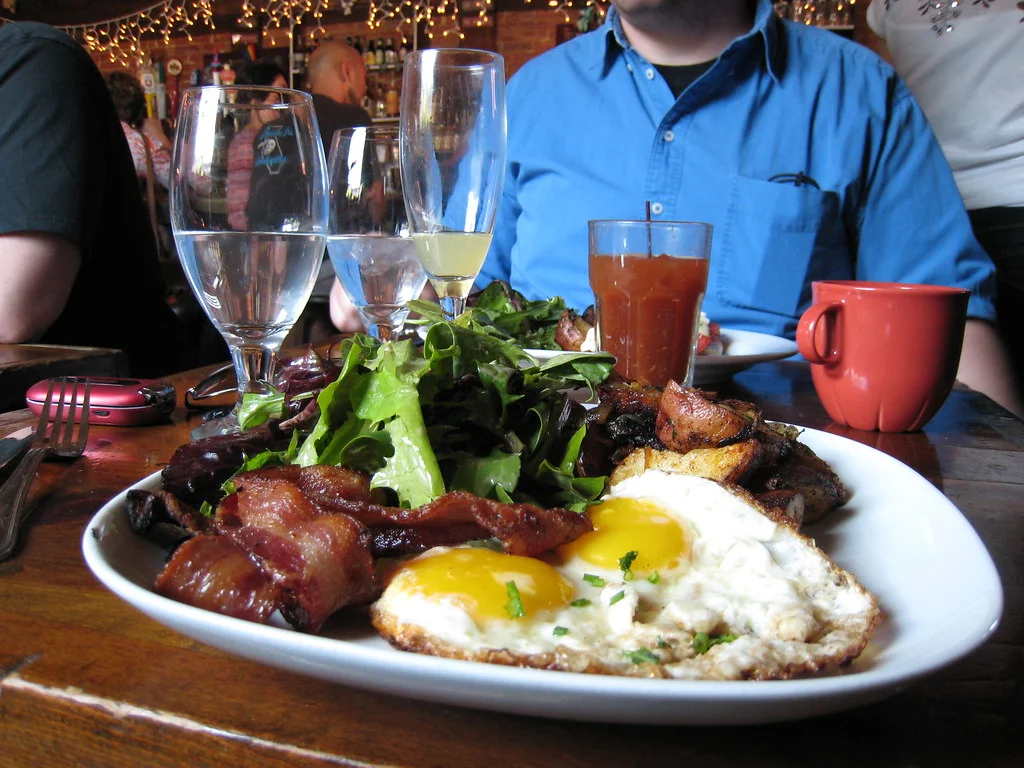
 Photo par Librarian Avenger via Flickr (CC BY 2.0)
In short:
- Brunch is a single meal served between 11 am and 3 pm that replaces both breakfast and lunch.
- The word dates from 1895: it was proposed by Guy Beringer in a London piece titled Brunch: A Plea.
- What separates it from a late breakfast is the compulsory savoury element, almost always egg-based.
- Budget 6 to 10 euros per person at home, against 20 to 35 euros at a city-centre venue.
The definition, in one sentence
Brunch is a single meal, eaten late in the morning, that replaces breakfast and lunch. The word is a contraction of breakfast and lunch, and it says exactly what it means.
The idea is old and documented. In 1895 the Englishman Guy Beringer published a short piece titled Brunch: A Plea, suggesting that the heavy Sunday post-church meal be replaced with something lighter, served around noon, with family or friends. The habit took hold in the United States in the 1930s, and became a weekend ritual in French cities from the 2000s onwards.
What is not brunch
The most common confusion is with a late breakfast. The difference rests on two simple criteria:
- There is savoury food. A breakfast served at noon is still a breakfast. With no eggs, no cheese, nothing savoury, it is not brunch.
- It lasts. Brunch runs two to three hours, served continuously, where breakfast takes twenty minutes.
The real timing, in venues and at home
In most places service starts between 11 am and noon and ends around 3 pm. Sunday carries the bulk of the activity, with Saturday far behind.
At home the optimal slot is 11:30 am. Earlier, guests have already had coffee and something to nibble, and the appetite is not there. Later, the meal spills into the afternoon and dinner becomes an awkward question.
What goes on the table
This is where most home brunches spiral into fifteen preparations and a wrecked kitchen. Four families are enough for a complete table.
| Family | Examples | Per person |
|---|---|---|
| Base | bread, bagel, pastry, toast | 2 items |
| Savoury | eggs, avocado toast, salmon, cheese, ham | 3 to 4 items |
| Sweet | pancakes, fruit salad, granola, jam | 2 items |
| Drinks | coffee, juice, water, tea | 2 cups + 200 ml juice |
The rule that simplifies everything
Only one preparation is made to order, everything else waits. In practice that means eggs are the only thing you cook while guests are there. All the rest, pancakes included, is made ahead or served cold.
Cooking times are covered in the poached egg timing guide, the most technical item on the table and the only one that punishes guesswork.
The budget, and what you actually pay for in a restaurant
A city-centre brunch costs 20 to 35 euros per person, often as an all-you-can-eat formula. The same content, made at home, comes to 6 to 10 euros.
The gap is not evenly spread. Three items carry most of the margin:
- Pastries, bought at 1 to 1.20 euro each and counted for considerably more in the formula.
- Smoked salmon, the most expensive item on the table, usually served in 30 to 40 g portions.
- Coffee, whose raw cost is around 50 cents a cup and which is almost always the weak point of the meal. The subject is developed in the brunch coffee guide.
What you legitimately pay for is not doing the dishes and not cooking while everyone else eats. That is a real service and it has a price.
Adapting the table to your guests
Brunch gathers six to eight people, so statistically at least one dietary constraint. Two cover most cases.
- Gluten free: the bread and pastry base disappears entirely, which empties the table if nothing is planned. Concrete options are in the gluten-free breakfast guide.
- Vegetarian: the savoury side then rests on eggs, cheese and avocado, which needs no extra preparation.
Frequently asked questions
What exactly is brunch?
Brunch is a single meal that replaces both breakfast and lunch, served between 11 am and 3 pm, always combining something sweet, something savoury and a hot drink. The word is a contraction of breakfast and lunch, proposed in 1895 by the Englishman Guy Beringer in a piece titled Brunch: A Plea. What separates it from a late breakfast is the compulsory savoury element and the fact that it is shared, over two to three hours.
What time does brunch start?
Between 11 am and noon in most places, with service ending around 3 pm. At home, 11:30 am is the most comfortable slot: late enough that nobody has already had lunch, early enough not to interfere with dinner.
What should you put on the table for brunch?
Four families are enough: a bread or pastry base, a savoury protein usually built on eggs, something sweet such as pancakes or fruit salad, and the drinks. Plan three to four savoury items and two sweet items per person.
How much does a homemade brunch cost?
Between 6 and 10 euros per person for a complete homemade brunch, against 20 to 35 euros at a city-centre venue. The gap comes mostly from pastries, smoked salmon and coffee, the three items carrying the highest margin in restaurants.
What is the difference between brunch and breakfast?
Breakfast is sweet, short and eaten early in the morning. Brunch always includes savoury food, is eaten between 11 am and 3 pm, and replaces two meals instead of one. A breakfast served late is still a breakfast.